
A Two Wheel Artisan
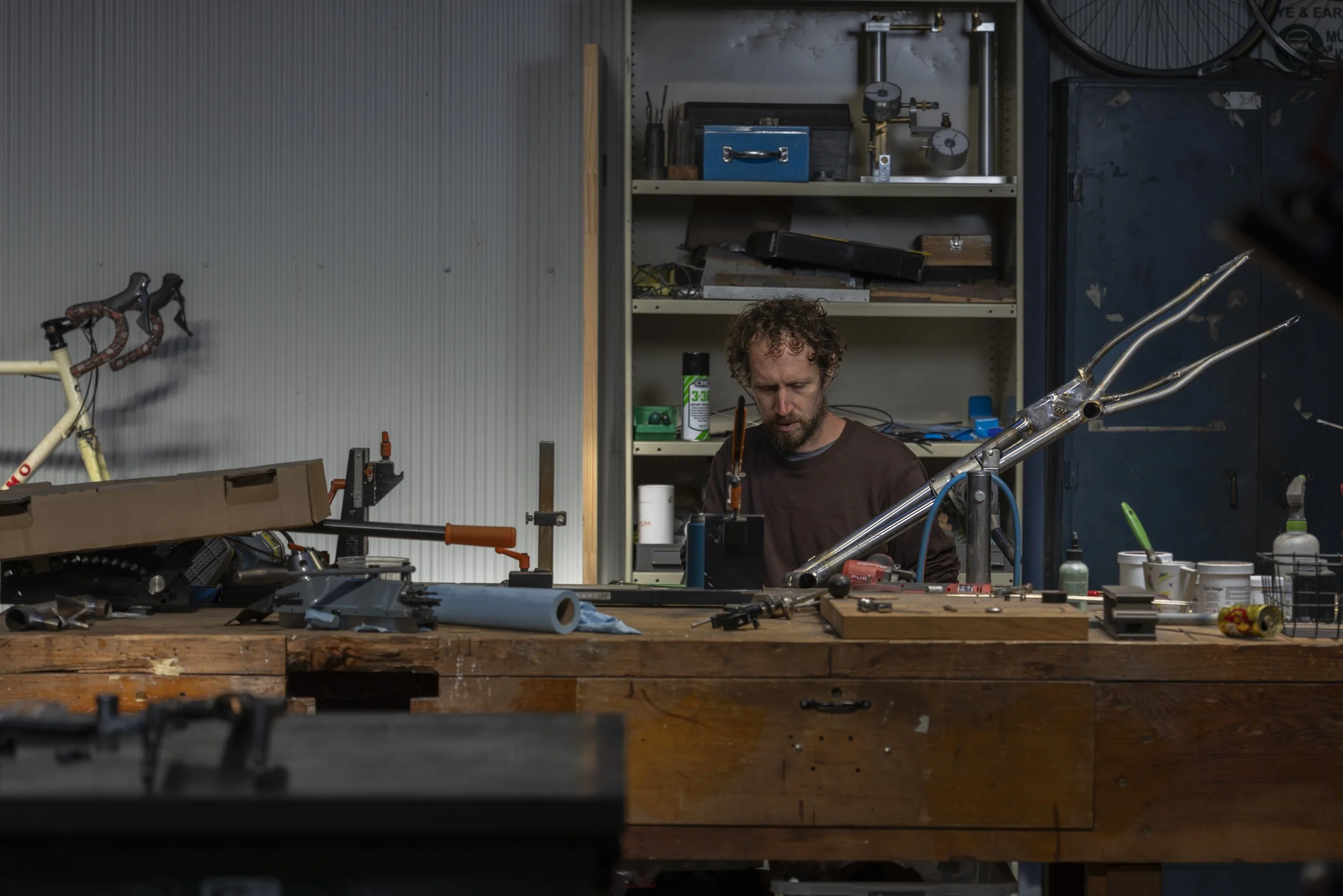
On a weekday morning in late April, just outside of Braidwood, I was driving on a dirt driveway through a closely planted pine forest. My goal was to meet and photograph Keith Marshall, who hand builds bicycles. Google Maps seemed to know where Keith’s address was and his directions matched where Google sent me, but I was driving deeper into a dense forest, not into the rural yard that I was expecting. After a few more turns along the dirt road, I saw a clearing through the pine trunks, with a large, corrugated metal structure in it. There were also a couple of cars parked nearby. Exiting my car, I headed to the open roller door, and peered inside the building. The immediate inner area had boxes and other things, including bike parts. I called out and a voice answered from somewhere within the main area but its source was hidden behind machines. After a moment, a tall, lanky, bearded Keith, appeared and extended his hand in welcome. I had arrived at a unique place, where steel pipes are transformed into touring bikes to take people on their own adventures. Possibly only one of about 20 such workshops in Australia hand building bikes for the commercial market.
Keith is a Braidwood local, born and raised in the area. His family own a local truffle farm, which Keith also works on, when he is not also working with one of his siblings at a vegetation clearing business, and when he is not building bikes. After high school, Keith studied at the Australian National University where he moved between courses on science, marine biology, engineering and philosophy. He couldn’t settle on one. During his studies he became interested in hand-building bikes. So, when he should have been paying attention in lectures he often found himself sketching out bike designs instead. Eventually, Keith decided that university wasn’t for him and he left to build bikes. As he said, “when you are in your 20’s, you think that you can do anything.”
In Canberra, he established Kumo Cycles. Kumo is the Japanese word for cloud, and a stylised cloud is the logo for his bikes. He had a special interest in Japan and eventually, he even established a relationship with a Tokyo bike shop. He explained that "I first got intrigued by Japan about 20 years ago, when I travelled there to work on some farms, I realised so much of the media, art and products that I consumed as a kid came from Japan. Fast forward 10 years or so and I visited every year delving into the bike culture and shops."
After a couple of years in Canberra he decided to move Kumo Cycles to Braidwood, where he started constructing an off-grid workshop among the pine trees on the family property. That was over ten years ago, and when we met, he sheepishly apologised for the ‘under construction’ appearance within his workshop. He is a busy man and building bikes takes priority over finishing off the interior of his workspace.
One of the reasons that Keith started building bikes was that it was hard to find a bike that supported his frame, while being capable of doing the touring cycling that he wanted to do. "I was motivated to build bikes partially by my love of making things, and partially by my need for damn tall bikes." However, building bikes just for himself was not a great business model. To help create a reputation for his brand, he built his first frames for five friends for $1000 per frame, which didn’t make him any money but did give him experience. He also proudly noted to me that although that was over 15 years ago, the frames are still in use.
Apart from a welding course, Keith is self-taught when it comes to building bikes. He later found a mentor in Queensland, but in the early days he was learning as he was building. "I am self taught, It's a steep learning curve, but I was lucky enough to end up with Darrell McCulloch as a mentor." That history is also reflected in the machines within the workshop, where many have stories of their own in how Keith acquired them, sometimes through serendipity. However, the precision machinery means that Keith has complete control over almost all aspects of the build. He even has his own painting room, so he no longer has to ship bikes interstate for a paint job.
He designs the bikes that he builds. The development of the designs comes from his own experience as well as a network of similar bike artisans across the globe. He uses a specialised bike CAD program, and will make mock-ups before manufacturing. One of the signatures of his Kumo Cycles frame construction is fillet brazing, where another metal with a lower melting point than steel is used to join two steel tubes together. This means that there is less impact on the steel being joined.
He makes between seven and twelve bikes a year, with builds taking two weeks to a month to complete. His longest build was four months because of the complexities such as additions to the frame, hand making a lot of the componentry, including mudguards that could be quickly removed for easy transporting of the bike. "The most involved build I undertook was a very detailed porteur for Mick Peel of Busyman Bicycles, I even TIG welded special stainless hardware to easily remove the mudguards."
While he will build just frames, his preference is to build the whole bike so that he can ensure that everything works together. He has a lot of interaction with clients. The best approach is when a customer has a clear idea about how they want to use their bike and Keith can discuss with them the most appropriate design. Some customers come with a component list that they want on the bike, but little idea about how they want to ride, making it harder for him to ensure that everything will unite into a bike that they will enjoy riding.
There is no typical customer for his bikes. However, when pushed, Keith sums it up this way, “they want a hand-made bike, they want it made in Australia, and they follow my brand.” Interestingly, because of his connections with Japan, his two biggest markets are Canberra and Tokyo.
Despite his bike building skills, business is not always smooth sailing. A US-based company that was machining a number of his small but vital components closed with only two weeks’ notice. This put a lot of hand-built bike makers across the globe in trouble because they were reliant on that specialist company. Keith isn’t sure why it shut but suspects that it was a casualty of President Trump’s tariffs, because the company imported a lot of its materials.
Where does Keith see himself in the future? Still hand-building bikes in Braidwood. However, as a true artisan, he wants to continue to improve. He wants to develop his skills by building better bikes. "I'm happy with my bike trajectory, I just want to hone my craft."
Keith’s dream bike is the one that he just completed, his 53rd frame. Well at least, it is his dream bike for now. It is a touring bike, and it has been designed with that in mind. It has a dynamo for powering electronics, an internal gearing system and plenty of points to affix items onto the front forks. "I love building a machine that is designed for adventure, my relationship deepens with the bike on every trip (and misadventure)." Keith is planning to use it in November this year when he does the Hunt 1000 bike packing event from Canberra to Melbourne along alpine dirt trails. Also, in mid-June, he wants to ride it to Sydney so that he can exhibit it, along with some of his other bikes, at SPOKEN, the hand-made bike show.
When most people think of bicycle manufacturing, they think of factories turning out thousands of repeat designs. They likely don’t think of a humble artisan sitting in an off-grid workshop, in rural Braidwood. However, thank goodness, enough people do think of him, so that Keith can continue to build his bicycles. Each bicycle is unique, and as it exits to a new home down the same dirt drive way among the pines that I drove along, it represents yet another work of this skilled two-wheel artisan.
Images of Keith’s completed 53rd frame build, the Kumo Overlander Prototype, are below.


