
Namadgi’s Alpine Dingoes
Alpine Dingo
Canon EOS R1 with a Canon RF 200-800mm F6.3-9 IS USM Lens [ISO 250, 800mm, f/9.0 and 1/800])
In early July I went to Namadgi National Park, south of Canberra, to photograph Alpine Dingoes (Canis lupus dingo), or Waragul in the local Ngunnawal language. I travelled to a location in the southern part of the park, where I hoped to be successful. I was basing my plan on two bits of information. Earlier in the year, an experienced ecologist had told me about dingoes in the area so I thought that was a good start. In addition, more recently, I was experimenting with AI and asked several models where I should go around Canberra to photograph dingoes, and they (Google Gemini and OpenAI ChatGPT) pointed me in the same direction - Microsoft Copilot told me that there were no wild dingoes in the ACT!
So with all that information, just after sunrise on a Saturday morning, in sub-zero temperatures, I was standing on a slope, looking over a grassy valley, scanning the area for dingoes. I was hopeful of success, because on the walk in, I had seen, about 200m away, what looked like part of a freshly killed kangaroo. However, finding dingos took time, and I was very glad that I had worn a long, thick down-filled padded coat to keep the cold at bay.
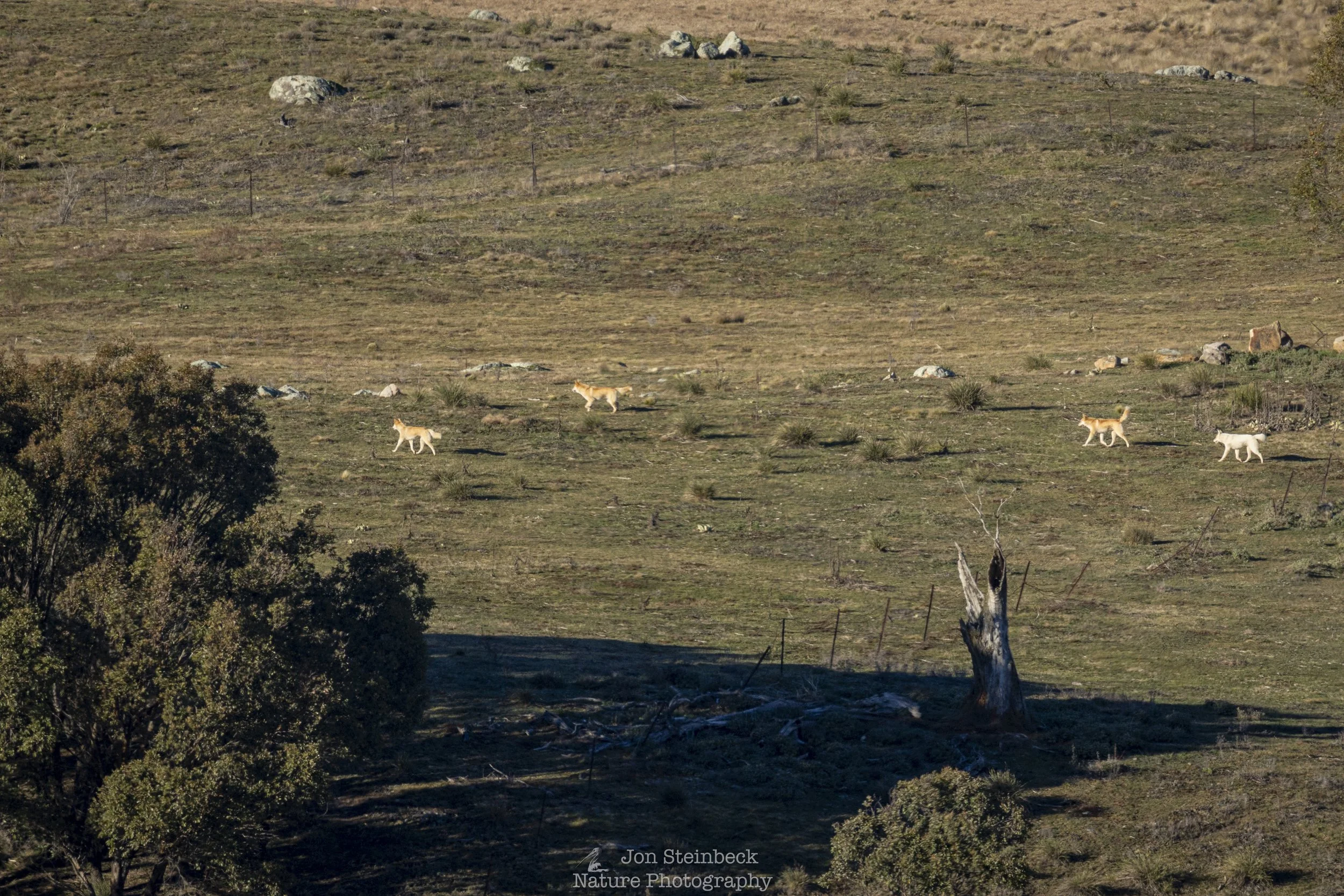
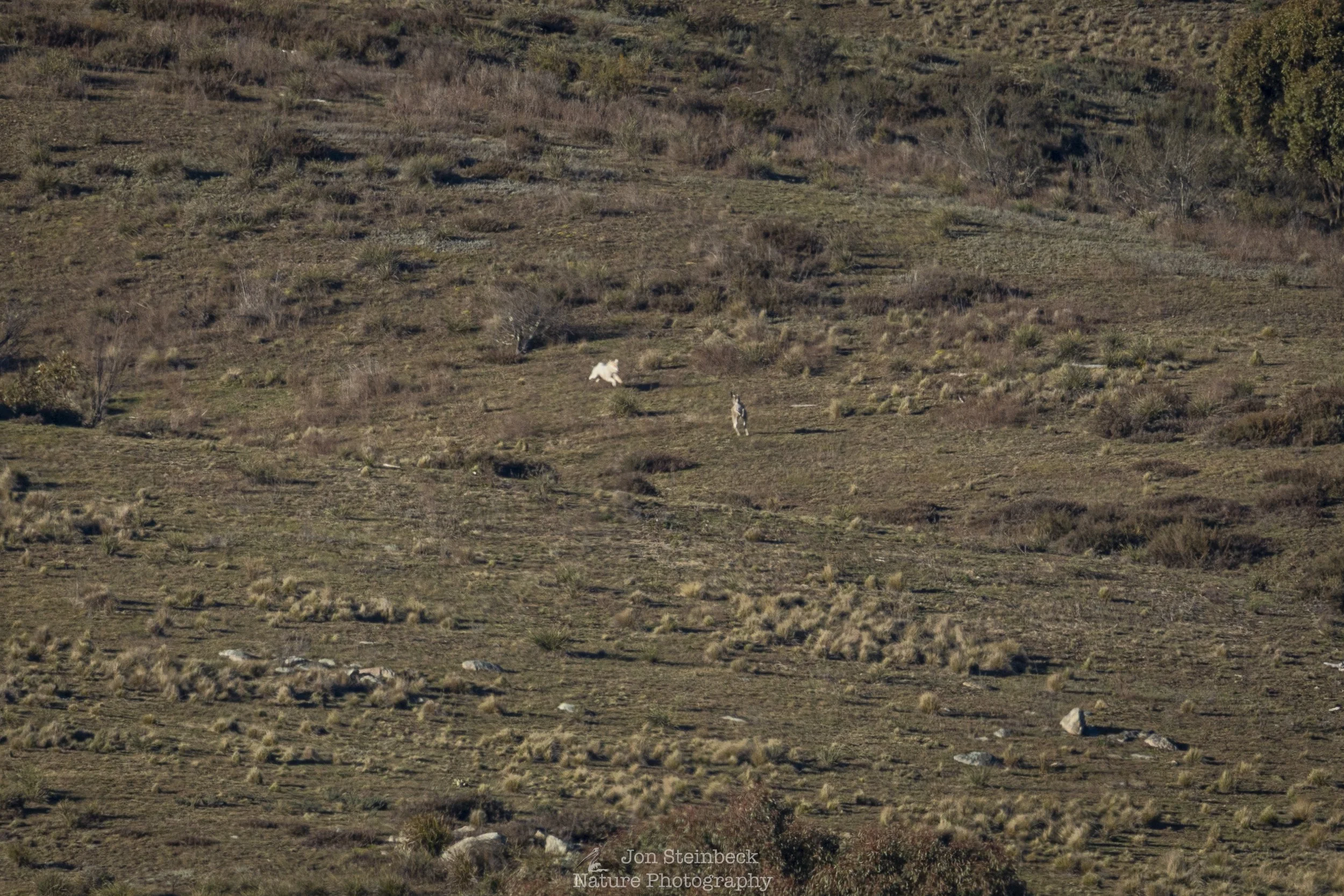
I waited for almost two hours before I had my first sighting. About 1.5km away, I saw a pack of four dingoes heading in a north-easterly direction away from me. They were heading in a straight line and the mobs of kangaroos near them were starting to move away. I watched the pack for a few minutes, and took some photographs, but the dingoes were too far away to photograph properly. Their heading took them into some dead ground from me and I lost them for a little while. Eventually, I noticed them again, ascending a rise, where the edge of the bush met the grassy valley. The dingoes were moving at a fast walking pace with a mob of kangaroos hopping away in front of them. Then, the white coloured dingo shot off from the others, sprinting towards the hopping kangaroos. I thought the dingos would hunt as a pack, so I was surprised when none of the others followed it. Most of the kangaroos kept going up the slope but a smaller one, possibly a young female, looped around, heading back down the slope, into the more open grassland. The white dingo was hot after it. The dingo had some speed, gaining on the kangaroo, which did not appear to have the pace to get away. Just when the dingo had almost closed the distance, the two animals disappeared behind a rise in the ground and didn’t reappear. I scanned to the sides of the rise, to see if the kangaroo or dingo were going to reappear but I couldn’t see either, or any of the other dingoes. I suspect that the dingo might have caught the kangaroo and then ate it where it died.
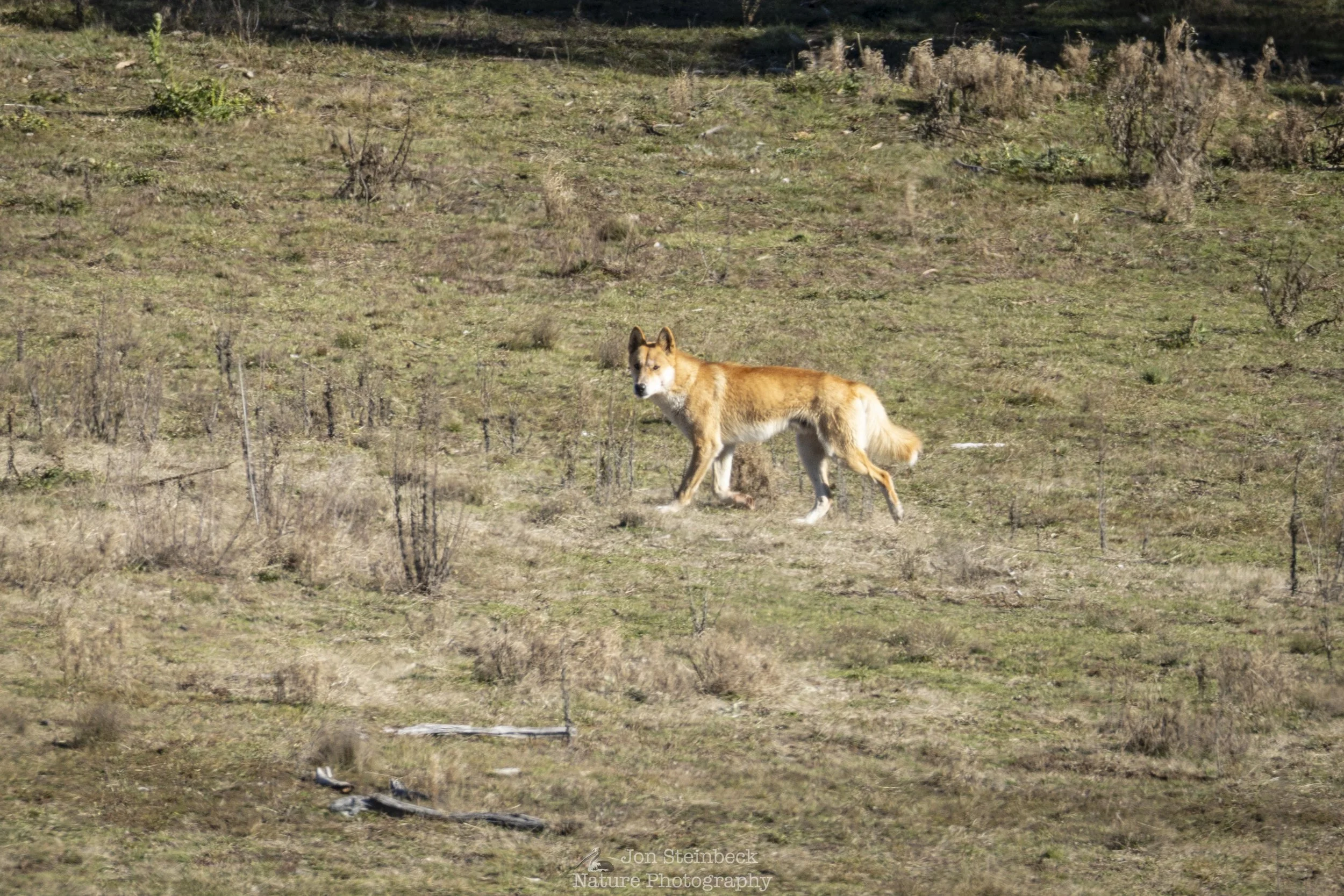
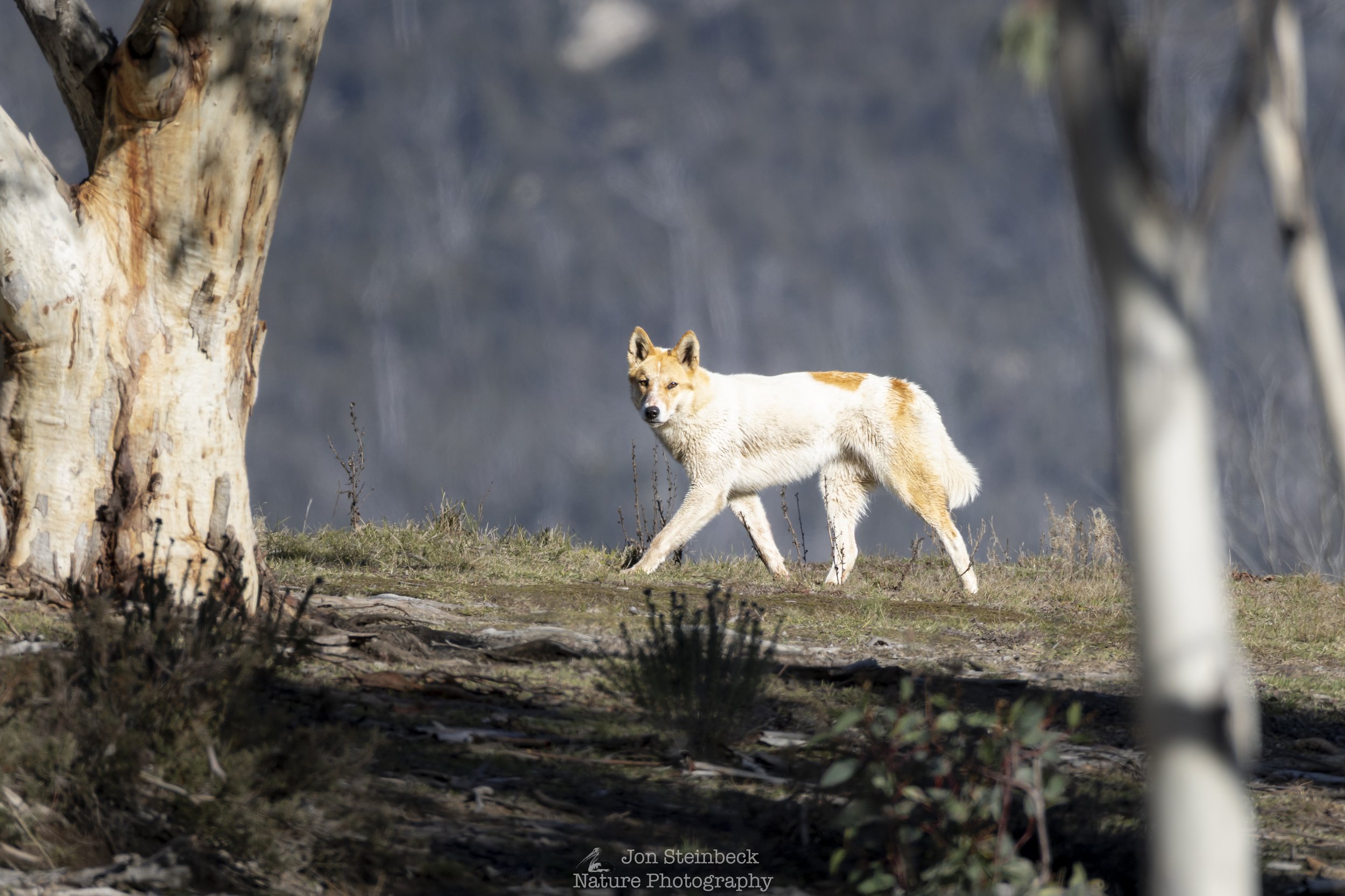
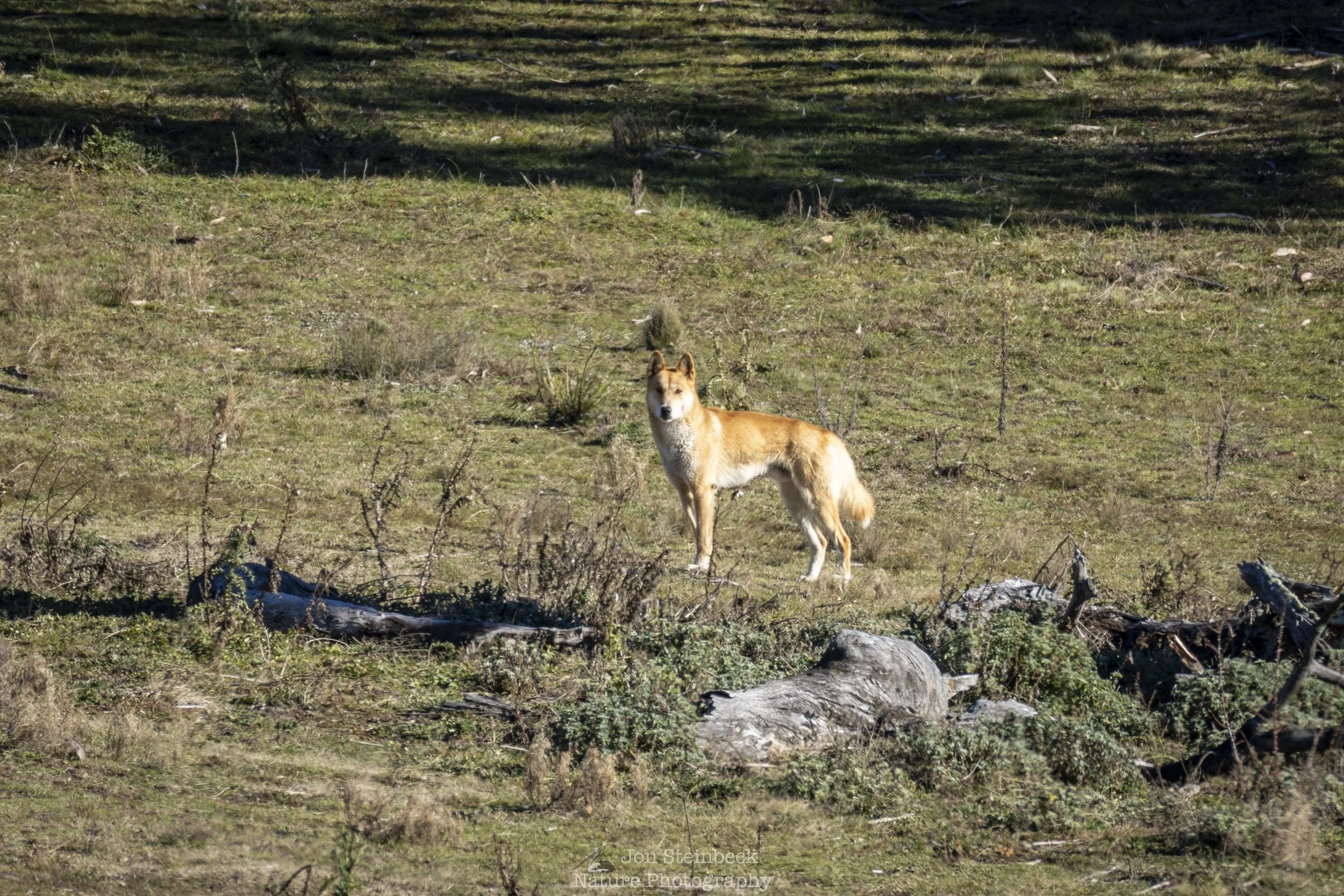
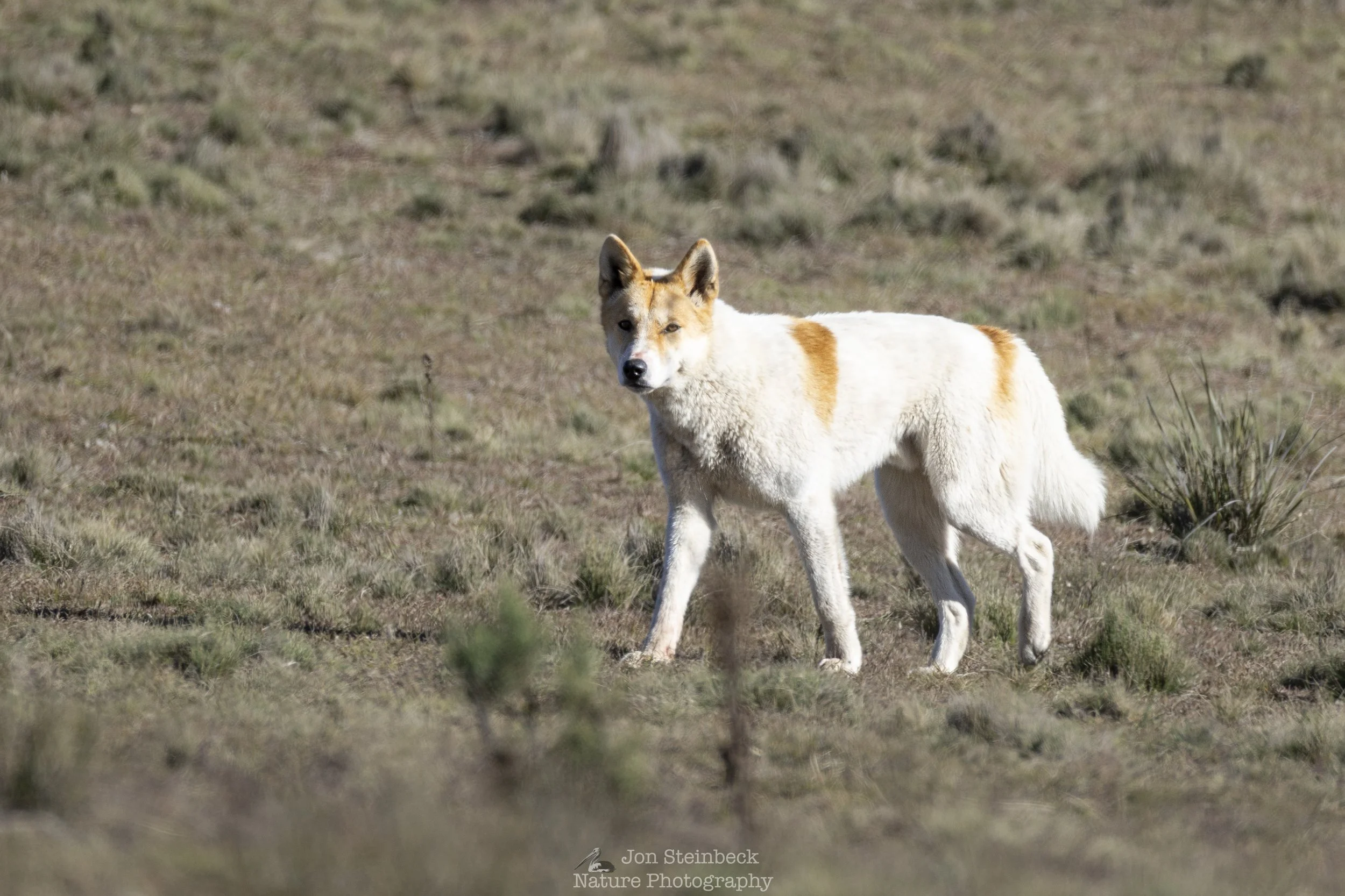
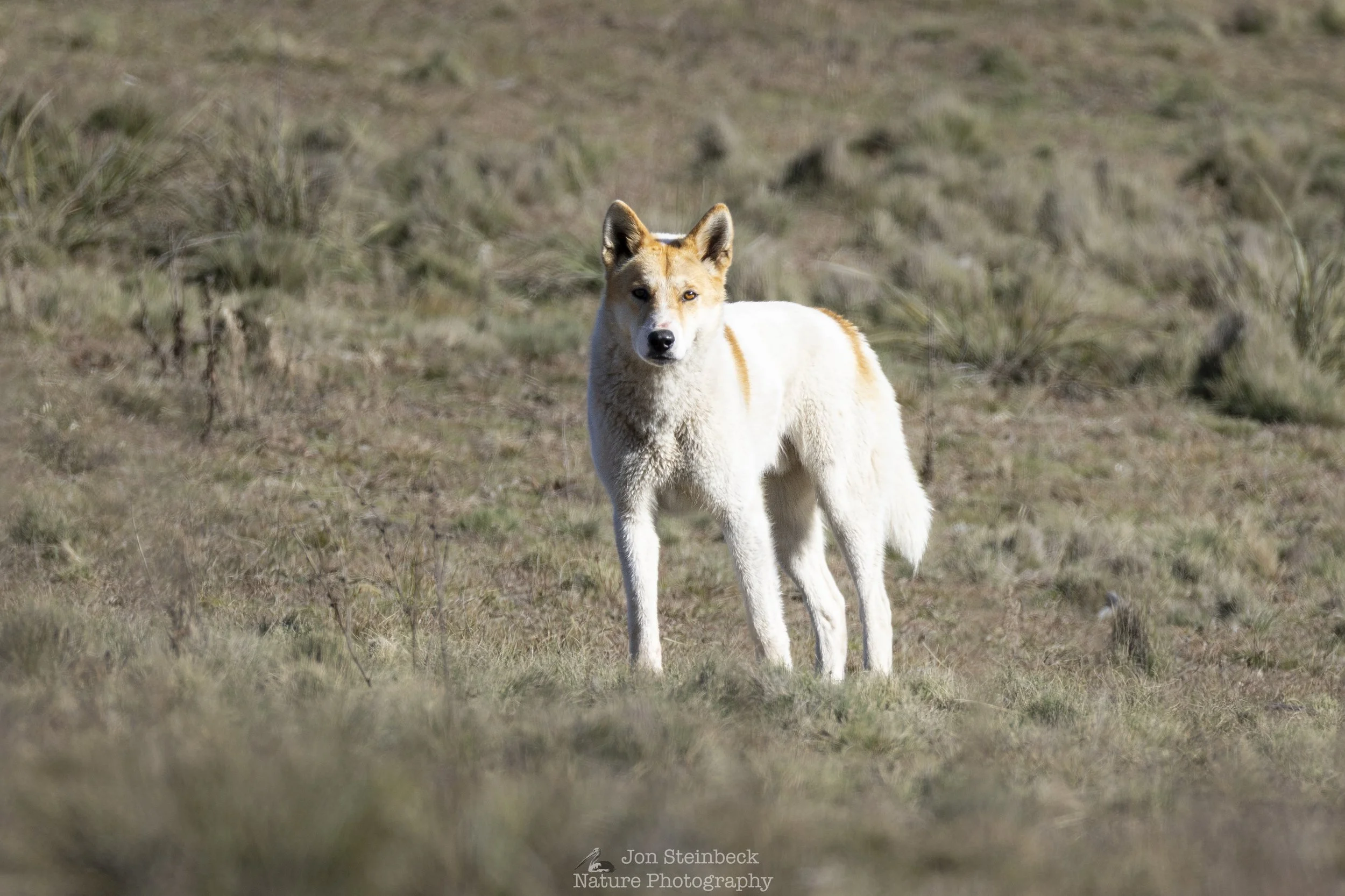
The images of the hunt show two distinct colours of the Alpine Dingos, and I have included images of the second group below that show the colours more clearly. The left hand image is the classic ginger colour with the white underparts and feet. The right hand image is also a dingo, but with more white on it. In winter, the coats of Alpine Dingoes are thicker than other dingoes to help them cope with the cold, frosty nights.
I was excited that I had seen that first group, and I thought that if I saw no more dingoes that day, I had at least watched an amazing natural contest for life, with my own eyes, not on a television screen. I never saw that group again, although about half an hour later, I heard howling start. The howls appeared to come from the east, west and north, like there were seperate dingoes or packs, around the edges of the valley. I looked to the kangaroos on the open grass and they appeared to have stopped eating. One group was looking to the west, where I thought some howling had come from. The howling only lasted for about 20 seconds, but the kangaroos kept looking. I also focussed on the area they were staring towards but no dingoes appeared.
Almost an hour passed after I saw the first group of dingoes, without any other sightings and I decided that I would head back to the car. Just after crossing a ridge, and descending the other side, I noticed a dingo walking around a tree about 100m away. There was a bit of dead ground just in front of me, and I was downwind of the animal, so I decided to try to get closer. The dingo was walking on a steady heading to the south-east, crossing diagonally from my right to left, and soon noticed me. I was worried that it was going to sprint off but it kept heading on its original course, crossing over the way that I head just walked. It was a ginger coloured dingo, the colour most people think of when they hear the word dingo.
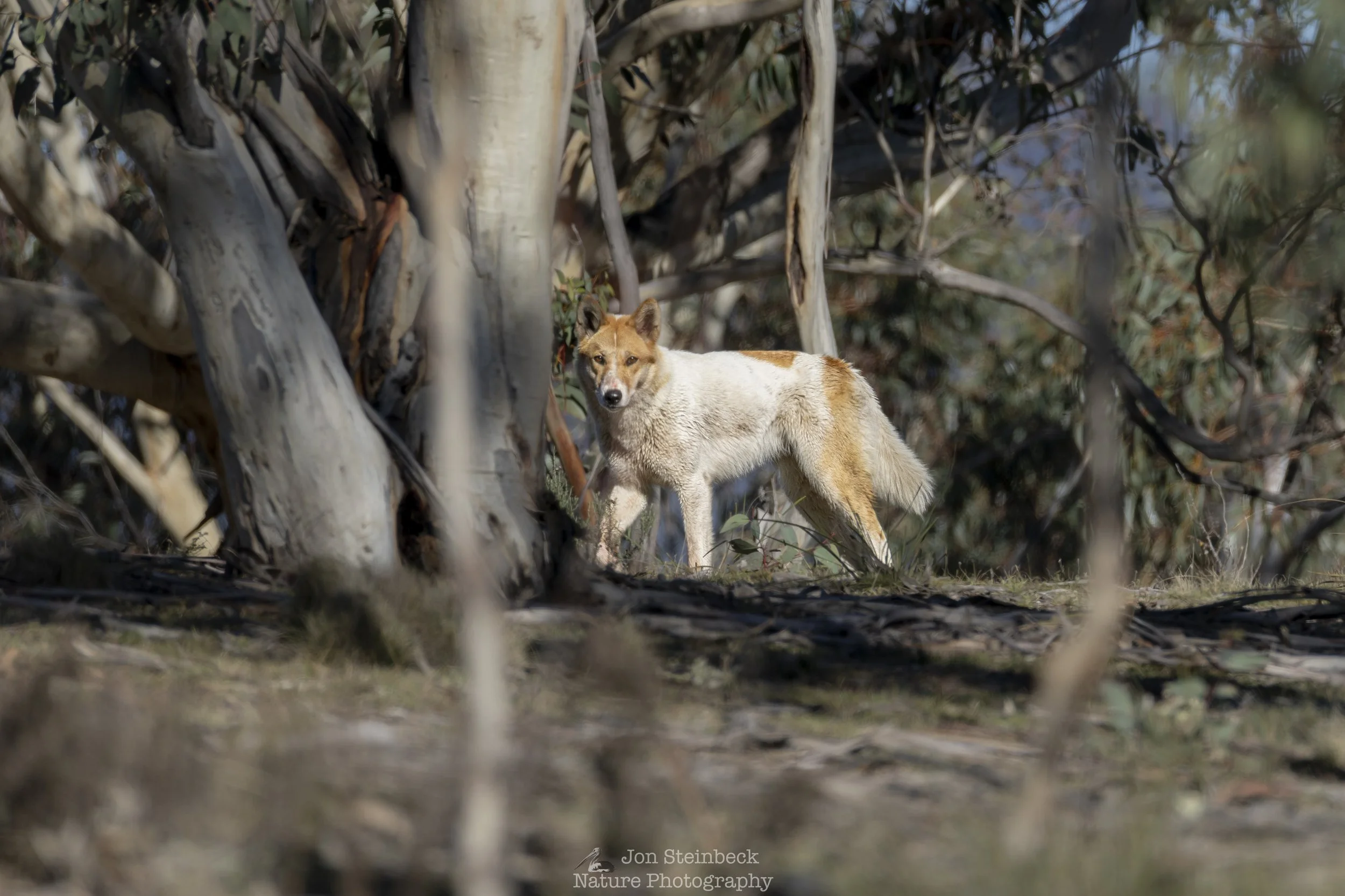
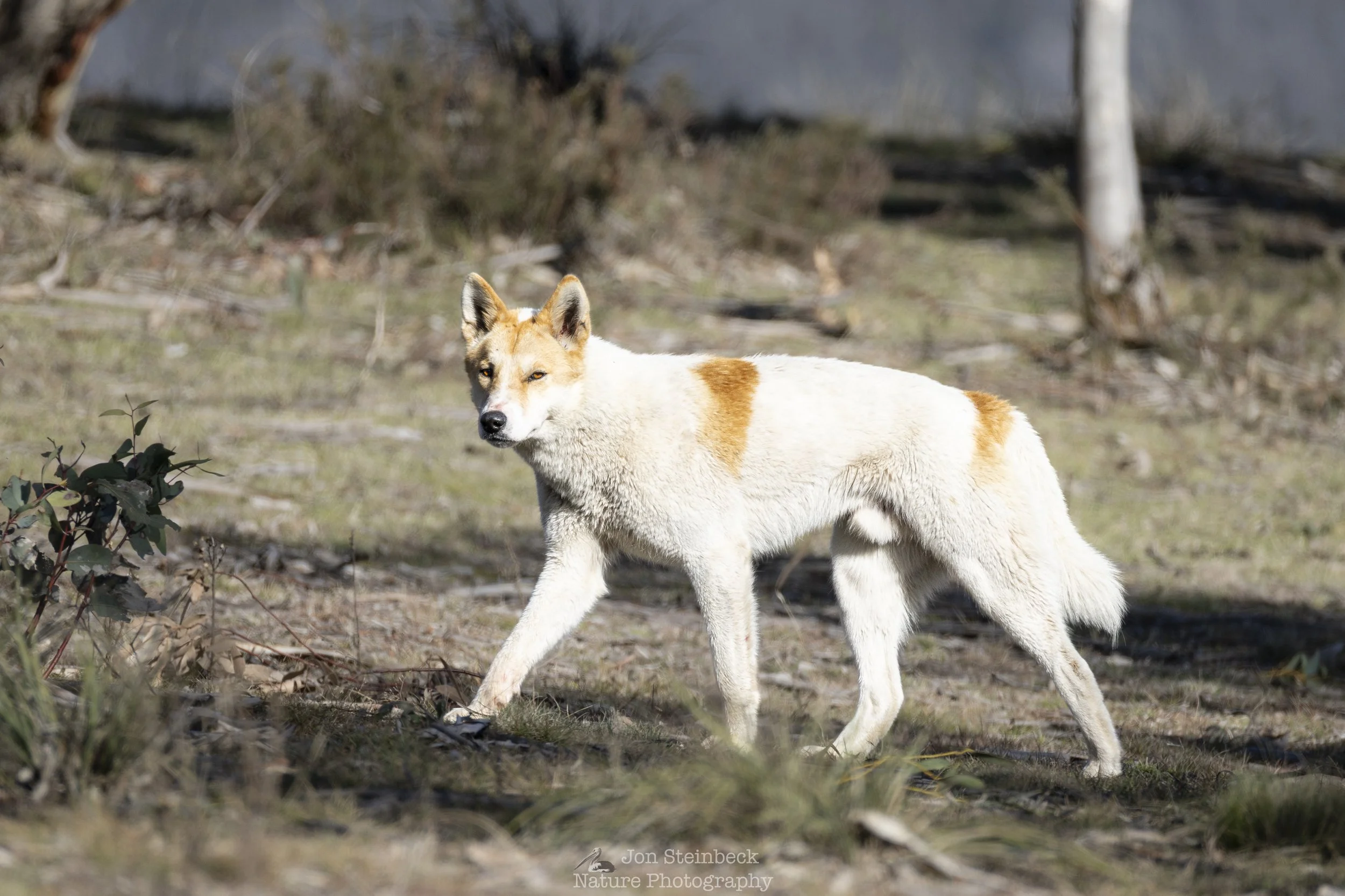
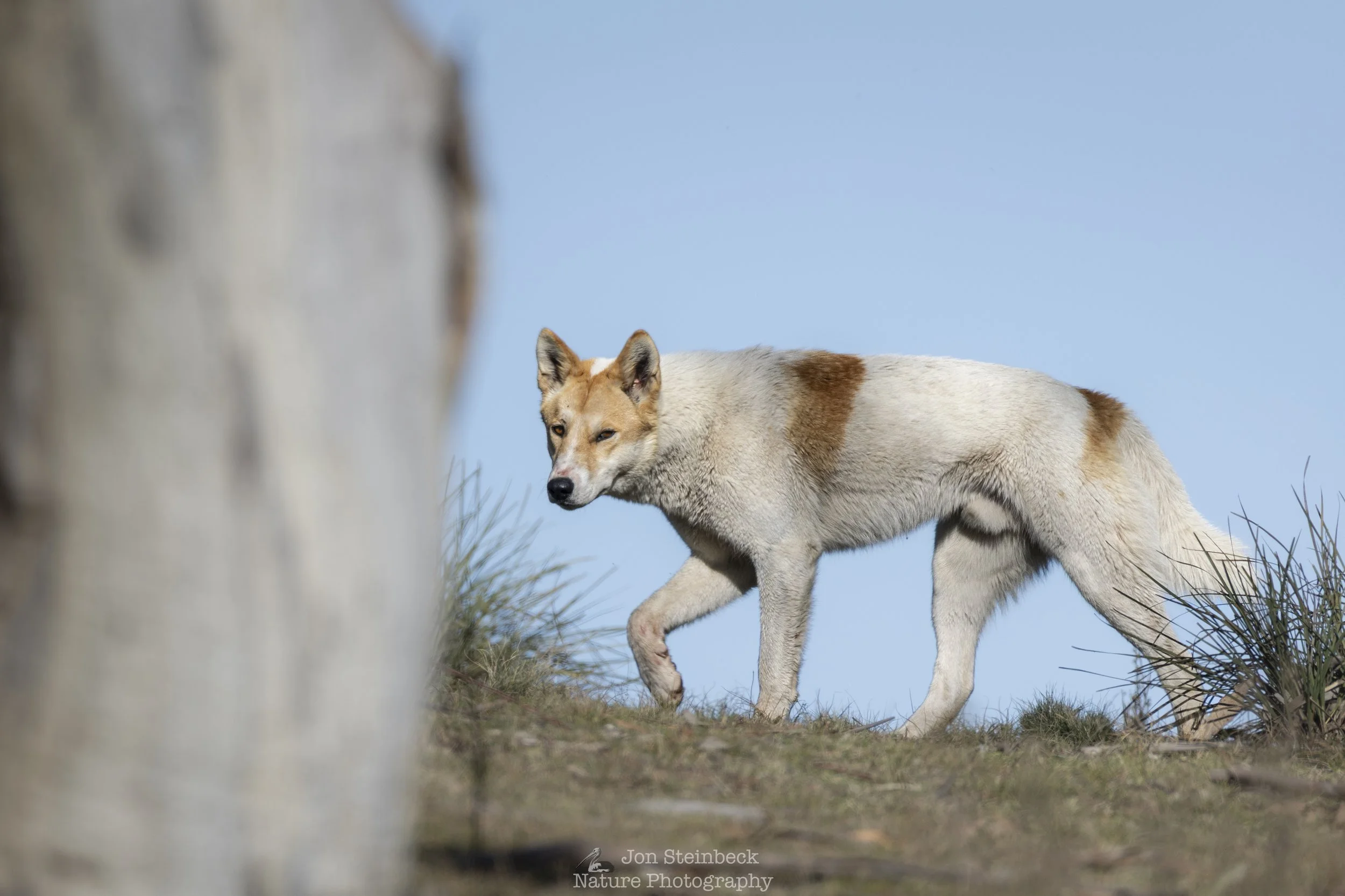
A second one was a little way behind it, and heading in the same direction. The second dingo, had a white coat with some ginger colouring on the face and hind quarters. Both of the animals were walking in a straight line, not rambling like pet dogs off a leash in a park. These dingoes were heading with a purpose, and were walking at a good pace. Walking past, they would look at me but occasionally they stopped to have a steady look before moving again.
Shortly before the second one made it to the tree line, I saw a third dingo, similar in colouring to the second one, although more white but with two distinct strips of ginger crossing over its back, one just to the rear of its front legs, and the other just in front of its tail. Its course was slightly closer to me. It saw me, but didn’t appear to deviate from its direction, but like the other two, it had a good look at me while it was walking. When it got to the top of the ridge, it paused to have a longer look before it scampered off.
I walked back up to the ridge, to the area that they had roughly walked into but decided against following them into the bush. I figured that they could easily outpace me through the trees and scrub, and they would easily hear me coming.
At present, July 2026, in the ACT, dingoes or waragul are classified as pest animals under ACT legislation, and are termed wild dogs. Within Namadgi National Park there is no killing of dingoes but outside of the park they are subject to control as a pest species. The designation of dingoes as pests is to help protect agriculture. The ACT government’s webpage explains the economic loss to farmers and also the mental stress to farmers of the loss of their animals. The classification of waragul as wild dogs is based on now disproven assumptions that the ACT dingoes are hybridised between dingoes and escaped domestic dogs. The May 2026 Adelaide University study showed that while a majority of dingoes in Australia have minor amounts of domesticated dog DNA in them, their genetic makeup is overwhelmingly still dingo. The lead author of the study noted to the ABC, "As far as genetics go, there is no number I can tell you where below that number or above that number it's a dingo or it's not a dingo…That becomes a matter of policy and opinion." Interestingly, in the report, the researchers wrote, “Notably, groups concentrated within southeastern Australia—that is, Mallee, East, and Alpine dingoes—also exhibit markedly reduced ancestral diversity…” [my emphasis added.]
The purity of dingoes is a source of tension. With some arguing that there are no pure-breed dingoes in Australia anymore, so lethal control measures are not actually killing a native animal. While others argue, with a number of DNA studies backing them, that dingoes are still primarily the same native animals that existed prior to the British permanent arrival in Australia in 1788. The ACT government has listened to the science and is looking at amending legislation to class dingoes or waragul as native animals. Hopefully, there will also be work done to help the farmers manage dingoes in a non-lethal way. Some farmers in other parts of Australia are also seeing a benefit to having dingoes around, because they help to suppress feral cats and foxes that prey on smaller domestic animals, such as ducks and chickens. It is a difficult balancing act but I hope the various governments get it right so as to preserve the dingoes, a truly beautiful animal.
The research also backed up that the Alpine Dingo is a specific sub-type of the Australian Dingo. The dingo has probably been in Australia for about 5000 years, potentially coming from south-east Asia. Since their arrival they have divided into two major types of dingoes, the west or nullabor and the east or curracurrang, roughly delineated by the Great Dividing Range, with the Alpine Dingo being part of the east group. The Alpine Dingo is slightly larger than the better known outback dingo and also grows a thick fur coat in winter. The Alpine Dingo can also have a wider colour variation than the outback dingo, something that originally seemed to suggest that these dingoes were hybrids with domestic dogs. However, science shows that the Alpine Dingo is not a hybrid, although it does have some domestic dog DNA. Having some DNA doesn’t make it any less of a dingo than a pure-breed and variation in coat colours may be more to do with adapting to the different environment in Australia’s alpine regions.
Summing up, that was my first encounter with wild dingoes, and I am hooked. I am not unbiased anymore, I am very pro-dingo. I loved that encounter with the Alpine Dingoes. They were magnificent, beautiful looking animals, deserving of protection. They were cautious about me but not scared, just going about their daily lives. I was mesmerised, almost giddy with excitement. Driving home, it took a while for me to calm down from that incredible experience. I was so pleased that I found those dingoes and I feel so fortunate to have had Australia’s native apex land predators so close to me.
