
About Alpine Dingoes
In July 2025 I photographed my first group of Alpine Dingoes, and I was immediately captivated by them. This page is intended as an information resource about these beautiful animals.
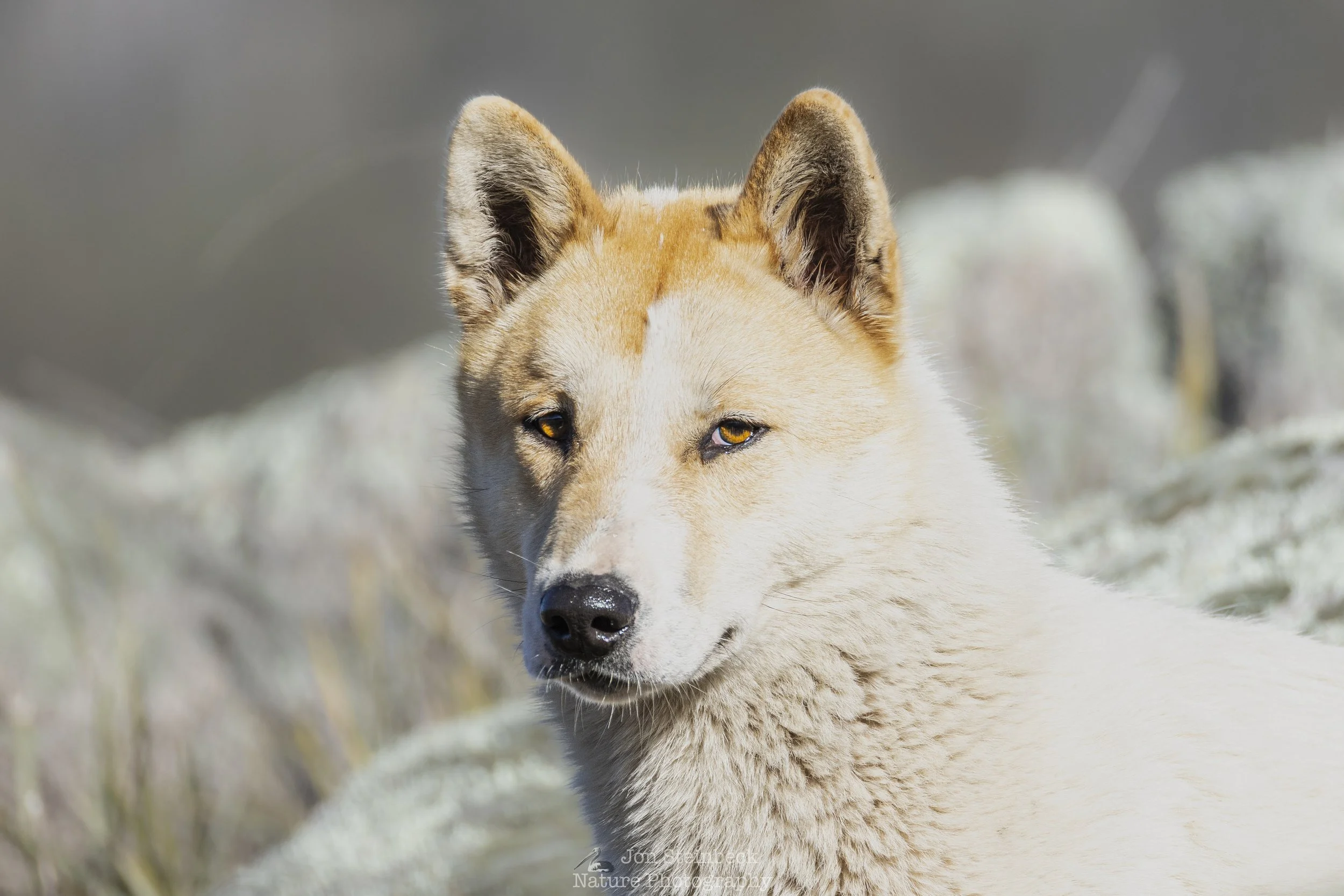
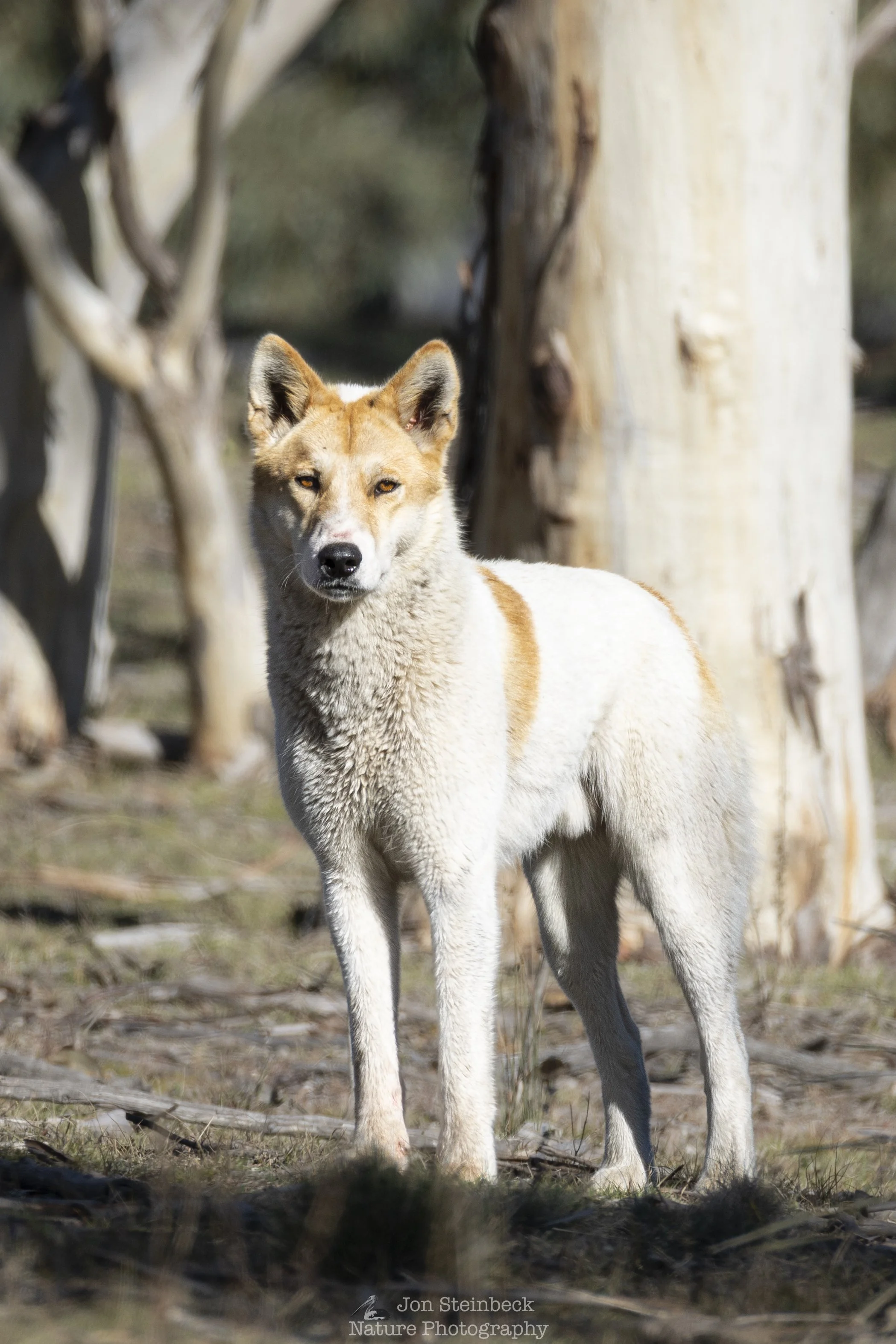
Wild dogs, dingoes and Alpine Dingoes - what’s in a name?
Wild Dogs? - The term ‘wild dog’ has evolved over time. In the early days of European settlement in Australia, the term wild dog was used regularly, without any pejorative meaning. It was a way of describing a dingo as a dog-like creature, like the Cape Hunting Dogs and other wild canids that Europeans were familiar with.
In modern times, however, its meaning has become less clear. This site reflects the current confusion about the term ‘wild dog’ where it groups dingoes, feral domesticated dogs and hybrids as all being ‘wild dogs’. That means signs in Namdgi National Park warning of 1080 poison use to control wild dogs are also targeting dingoes.
The ACT’s own site on dingoes or the Waragul, shows a different story. In 2024-25 Dr Kylie Cairns tested 50 samples from Namadgi National Park and found that 47 returned as pure dingo DNA. Two had greater than 93% dingo DNA and one was a feral dog. Likewise, Misha, an Alpine Dingo at the National Zoo and Aquarium, which was originally taken from Namadgi by well-meaning people who thought it was a dumped pet, had 100% dingo DNA.
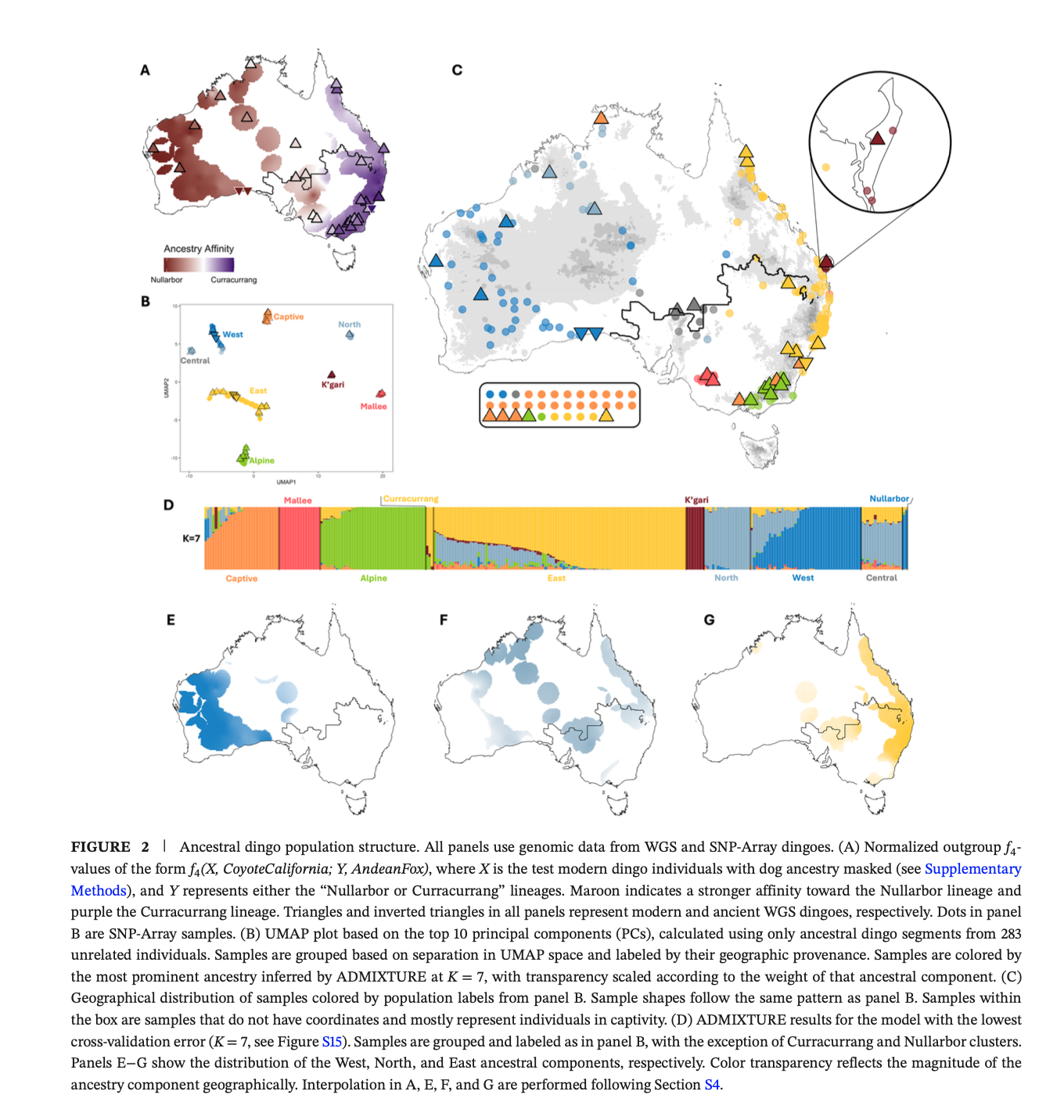
Dingoes or Alpine Dingoes? - Really, both terms are correct, and I like using the term Alpine Dingo because that is the type of dingo that I encounter when I see them in Namadgi. There is also scientific evidence to justify using the term Alpine Dingo. The graphic below is taken from Ravishankar with the green showing Alpine Dingoes as a distinct genetic sub-group. They are not a distinct species or sub-species but at the genetic level scientists can tell they are from the Alpine region of Australia. So yes, they are definitely still dingoes, and they could be described as dingoes from the Australian alpine region, but calling them Alpine Dingoes just seems so much easier.
General information
The dingo can have a head that appears to be too big for its body. Its jaws are great for biting, ripping and tearing, but they can also be used for more delicate work, like biting berries from trees (Breckwoldt).
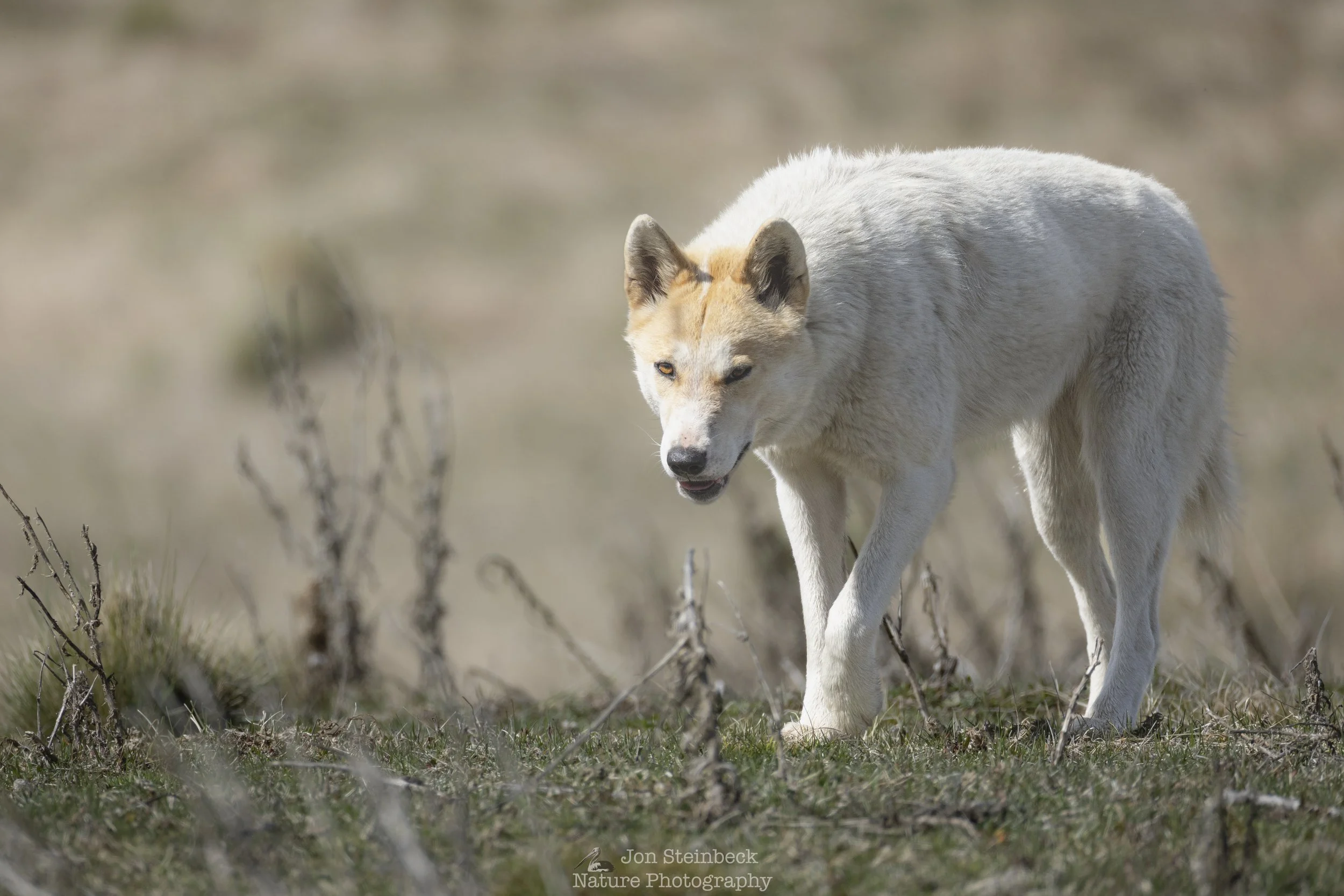
The appearance of Namadgi’s dingoes can confuse people who are expecting the well-known ginger variety. The Alpine Dingoes normally show a lot of cream, but also have a variety of other colours, including black. The image below, sourced from Wikipedia, was painted in 1772, 16 years before European settlement, and shows a dingo that was darker than most people would think of a dingo, but well before any interbreeding with domestic dogs could have occurred. So, dingoes that are not ginger coloured, have been in Australia well before the arrival of Europeans.
In Namadgi, it appears that the dingoes stay in the major valleys of the park, and do not move out of them to interbreed. There may also be more than one pack in a valley, and if that is the case, the separate packs normally share the valley without resorting to conflict, possibly because of the plentiful food and water in the valleys. There are estimates of 20-50 dingoes per the four valleys, giving a rough estimate of approximately 200 dingoes in total across the park (Vandersteen Webinar).
Dingoes are known for their howling, and for many visitors to Namadgi, they will only hear that howling in the distance without ever seeing a dingo. The howling is probably a bonding activity across a long distance within a social group. Different dingoes may even use different pitches to distinguish themselves. Some studies suggest that generally only males howl, with only alpha females howling as part a relationship with the alpha male (Breckwoldt).
Dingoes do also bark, although it is short, and normally only done when they are warning other group members of a threat. Dingoes also moan and have an agitated cough as well. They can also communicate with their bodies, showing supplication to dominant dingoes. They can also show dominance in a group by arching their back, curling their lips, or raising their tails.
Smelling is their key sense, and it is easy to observe dingoes sniffing the ground as they try to understand a scent.
The average lifespan of a dingo in the wild is about ten years.

Food
Dingoes eat roughly 7% of their body weight each day, or about 1kg of food for the normal adult dingo (Breckwoldt). In Namadgi, Eastern Grey Kangaroos and Red-necked Wallabies are plentiful so dingoes mainly eat them. They will also eat birds and other small creatures, although this does not seem to be normal.
While dingoes can hunt in packs, they tend to hunt as individuals. Even when I have seen groups of dingoes out near kangaroos, I have only seen an individual dingo launch a chase after a kangaroo. During a chase, a joey may fall out of a pouch so even if the dingo doesn’t catch the adult, it may still get a feed.
For water, dingoes will obtain a lot of their requirements from their prey, although Namadgi also has plenty of rivers if the animals need to supplement it. With lactating females sometimes requiring extra liquid.
Young dingoes will start with milk from their mothers but will graduate to meat. Once they are hunting outside, initially they may target smaller animals like insects and birds, but as they grow they will focus on kangaroos (Breckwoldt).
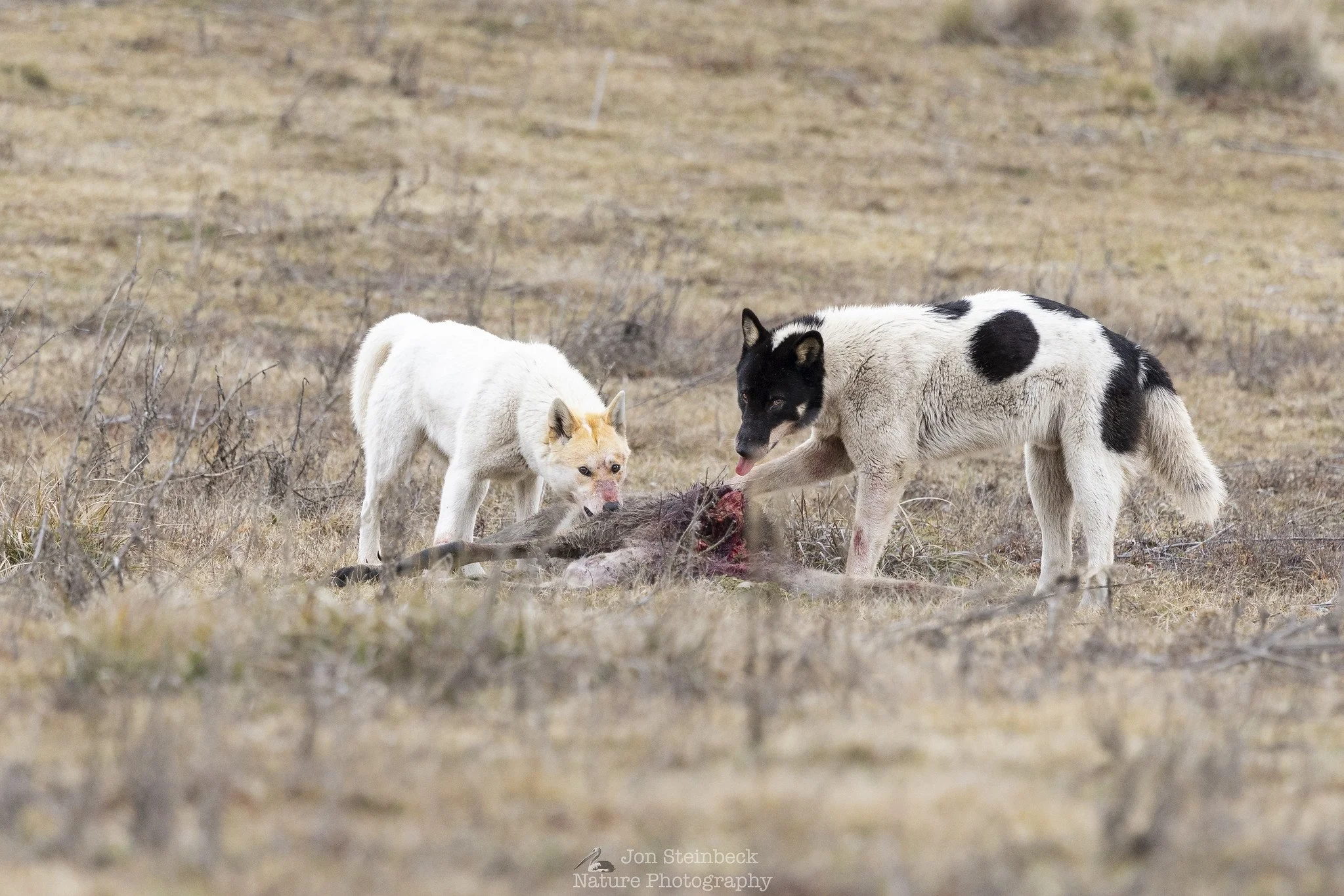
The picture to the side shows a male, with the black head, and a female eating a recently killed kangaroo. In typical pack dynamics, the male ate first and then the female joined him. They mainly ate separate parts of the kangaroo, with the male seeming to favour the kangaroo’s stomach lining.
While it is unlikely that the dingoes in the core part of the park consume farm animals from the neighbouring properties, in other parts of southeast Australia they do. However, dingoes do still tend to favour native wildlife over farm animals, with farm animals making up less than 10% of examined dingo stomach contents. With most that being carrion from animals that were already dead. Dingoes, like other large carnivores, do sometimes kill in excess of requirements, although it is not clear if this happens in Namadgi (Breckwoldt).
The Den
In Namadgi, dingoes have plenty of choices for dens. The granite rocks give stable locations for dens, which dingoes can improve them through their very good digging ability. These dens are probably normally used by the local pack, while the non-alpha females that are pregnant, will potentially search out areas under logs or trees, smaller places to breed in.
Dingoes will change dens regularly, although in Namadgi, they probably don’t move far. Scientists believe that dingoes choose den locations that are near water and plenty of food, which Namadgi has in abundance. Also, dingoes prefer an opening that doesn’t face the rising or middle of the day sun (Billabong Sanctuary).
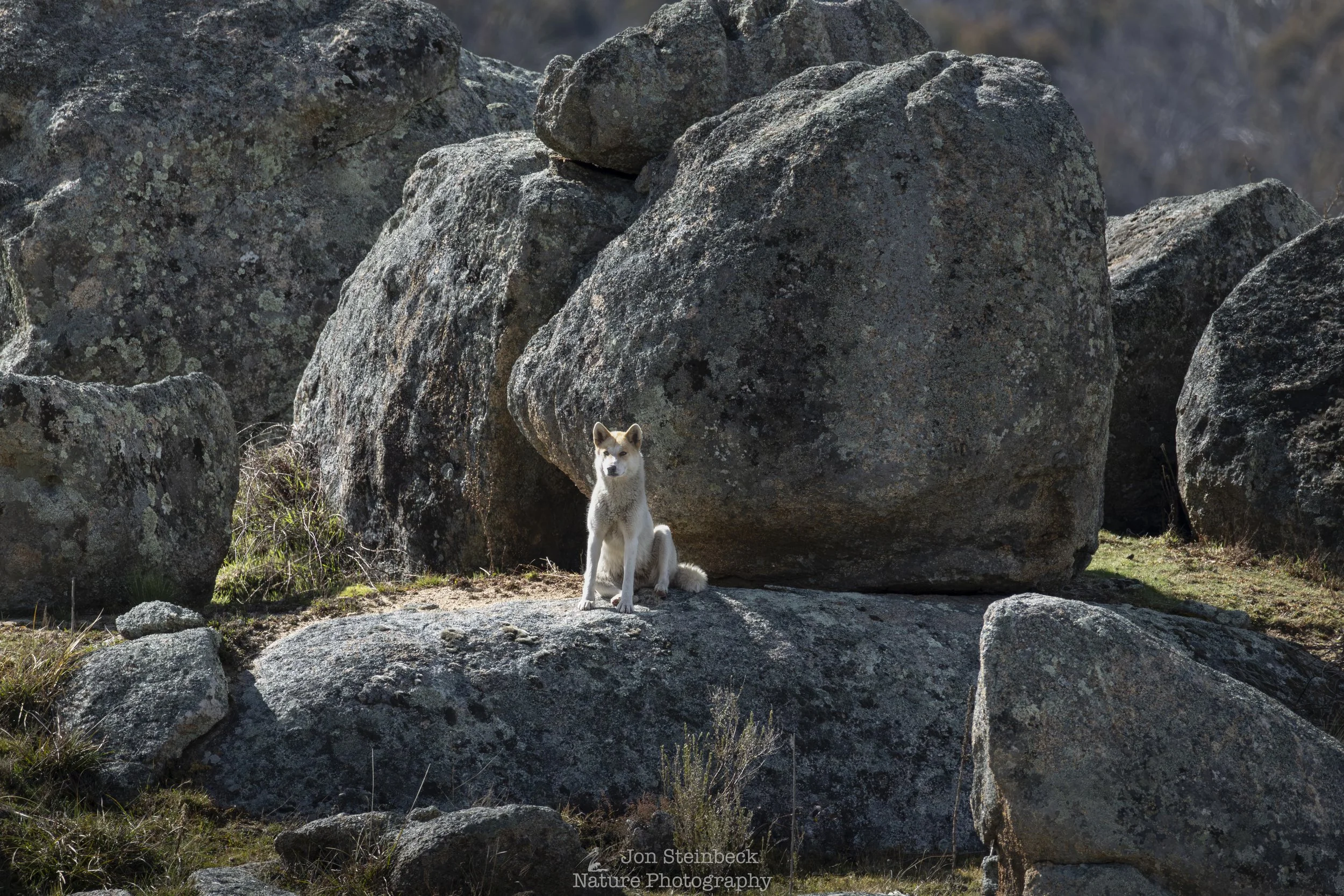
The photo to the left shows a female Alpine Dingo that has just emerged from the den opening on the left. This den had three to four dingoes emerge from it, although more may have been inside.
Breeding
Breeding starts in April-June with a gestation period of about 63 days, meaning that litters of about four to five are born to coincide with the start of spring. Pups will consume milk for about two weeks, before pack members start regurgitating freshly eaten meat for the pups to consume. Shortly afterwards, they will start bringing back bits of fresh meat for the pups to try. After about three weeks pups will venture out of the den, and by eight weeks they are fully weaned and will leave the den for good. Females show the pups how to hunt and after about 16 weeks the pups are self sufficient. They may stay with the pack until the next breeding season, when they will leave. Dingoes are not normally sexually active until they are two years old (Billabong Sanctuary).
Generally, it is only the alpha male and alpha female that breed. Should a non-alpha female become pregnant, the alpha female may kill the pups. The non-alpha female may therefore try to hide her pups in an alternate den, but that is not normally successful.
Other members of the pack will assist the breeding pair by bringing food back to them and the pups.
What to do if a dingo approaches you
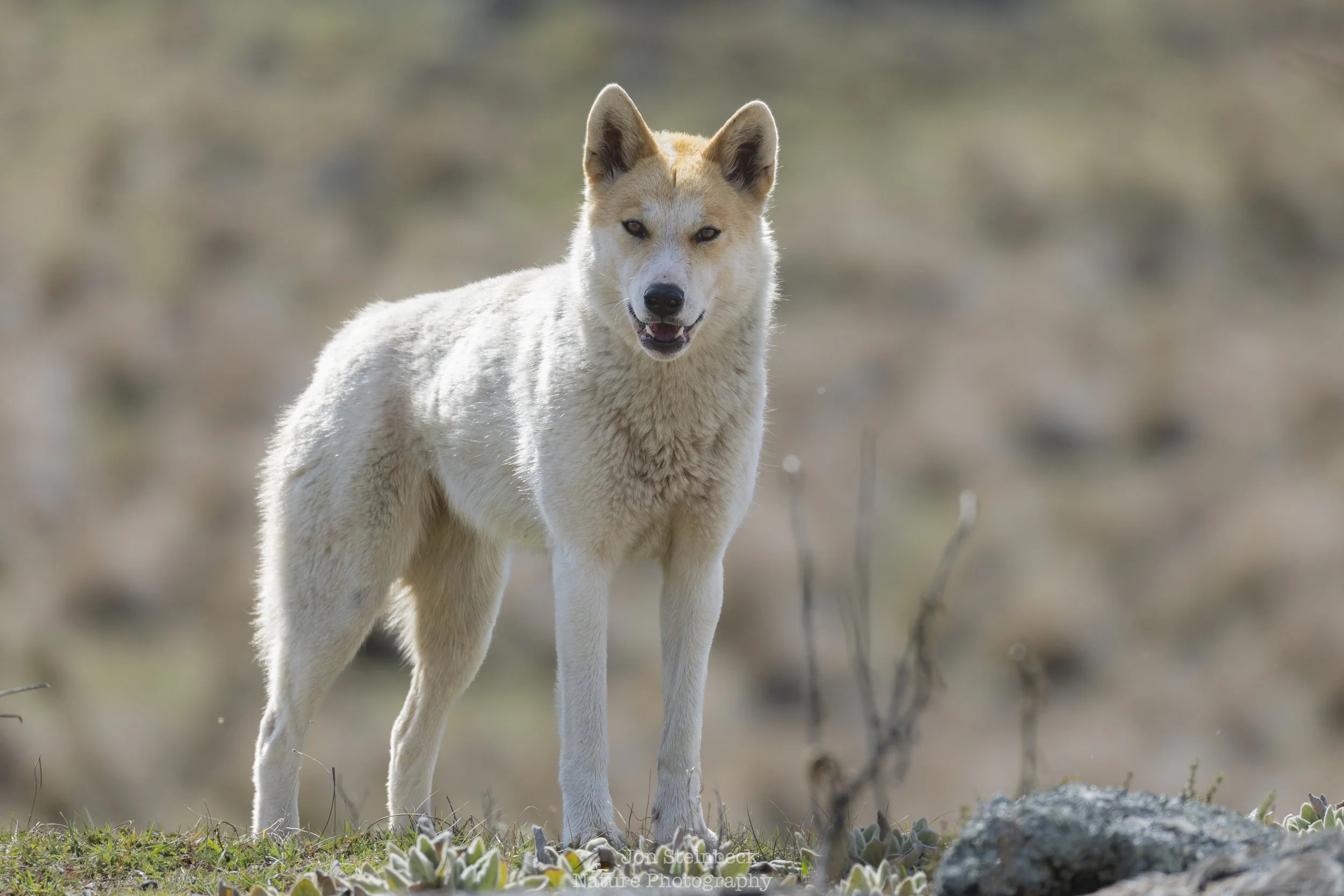
While K’gari/Fraser Island has experienced deaths and dingo attacks, this has not been the case in Namadgi. Dingoes tend to keep their distance from visitors, and visitors should do the right thing and not feed dingoes. If people regularly feed wild dingoes, then the animal can start associating humans with food. While some visitors may find this harmless, if a person is not aware of this habituation, they could see an approaching dingo as a threat, and try to flee. Fleeing from a dingo can actually be dangerous, because it can trigger a hunting reflex in the dingo.
The the advice (as at 16 September 2026) from ACT Environment about what to do if a dingo approaches you is:
In the unlikely event of threatening behaviour:
stay alert but calm
do not run or wave your arms because it can trigger an attack
face the animal, stand still at full height, fold your arms across your chest, and keep eye contact with the animal.
calmly back away, and if you are with another person, stand back-to-back.
References and further reading
Billabong Sanctuary Townsville, Dingo
Breckwoldt, Roland. (2025, 29 July). Dingo: The true story of Australia's most maligned native animal. Allen & Unwin.
Ravishankar, Shyamsundar and Nguyen, Nhi Chau. (2026, 13 April). Paleogenomics-Informed Inferences of European Dog Admixture Enables Scalable Dingo Conservation. Conservation Letters. https://doi.org/10.1111/con4.70052
Vandersteen, James. (2026, 19 August) Webinar: Understanding the Waragul (Dingo). ConservationACT. https://www.youtube.com/watch?v=tH4Czw1CwV4&t=1990s