
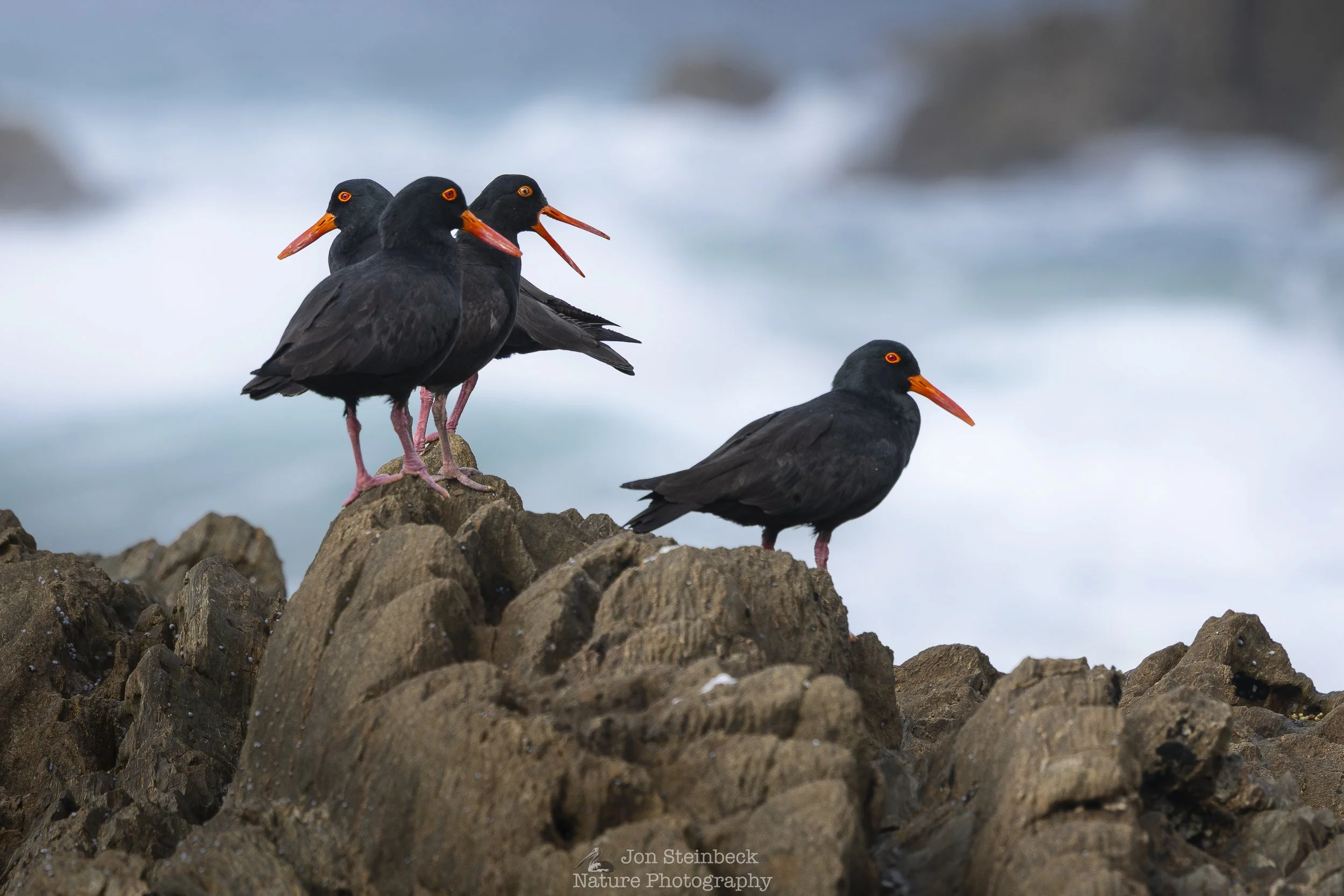
Sooty Oystercatchers together
Sooty Oystercatchers on a rock
Canon EOS R1 with a Canon RF 100-500mm f/4.5-7.1 L IS USM Zoom [ISO 250, 500mm, f/8.0 and 1/800])
In late August, I was down at 1080 Beach on the south coast of NSW, and starting to get worried if the H5N1 bird virus had already impacted some of the seabirds there because I had not seen many around, despite there normally being plenty. However, walking along the rocks, I came across these four Sooty Oystercatchers (Haematopus fuliginosus) together. They were standing on the rocks while the tide was ebbing. Sooty Oystercatchers normally prefer this type of rocky shoreline, while the Pied Oystercatchers are generally on sandy shores.
Interestingly, a study conducted over the summer of 2008-09 on the south coast of NSW, just north of Batemans Bay, found that male and female Sooty Oystercatchers ate slightly different prey items. By way of context, the beak of the female is thinner than the male’s, and about 19% longer, while the male’s beak is broader than the female’s. Females generally ate softer prey items, including fish, crabs and bluebottle jellyfish that no males ate. The males ate hard shelled items, particularly shellfish, some species of which the females didn’t consume. The females were generally also more efficient in gaining weight from what they ate. It wasn’t clear if this difference in eating was a way to avoid competition between the sexes, or a by-product of partner selection evolution that had resulted in the difference of beak sizes. It’s amazing how nature works!
The article is Aplin, L. M., & Cockburn, A. (2012). Ecological selection and sexual dimorphism in the sooty oystercatcher, Haematopus fuliginosus. Austral Ecology, 37(2), 248-257. https://doi.org/10.1111/j.1442-9993.2011.02263.x
The same group of Sooty Oystercatchers
Canon EOS R1 with a Canon RF 100-500mm f/4.5-7.1 L IS USM Zoom [ISO 250, 500mm, f/8.0 and 1/800])
