
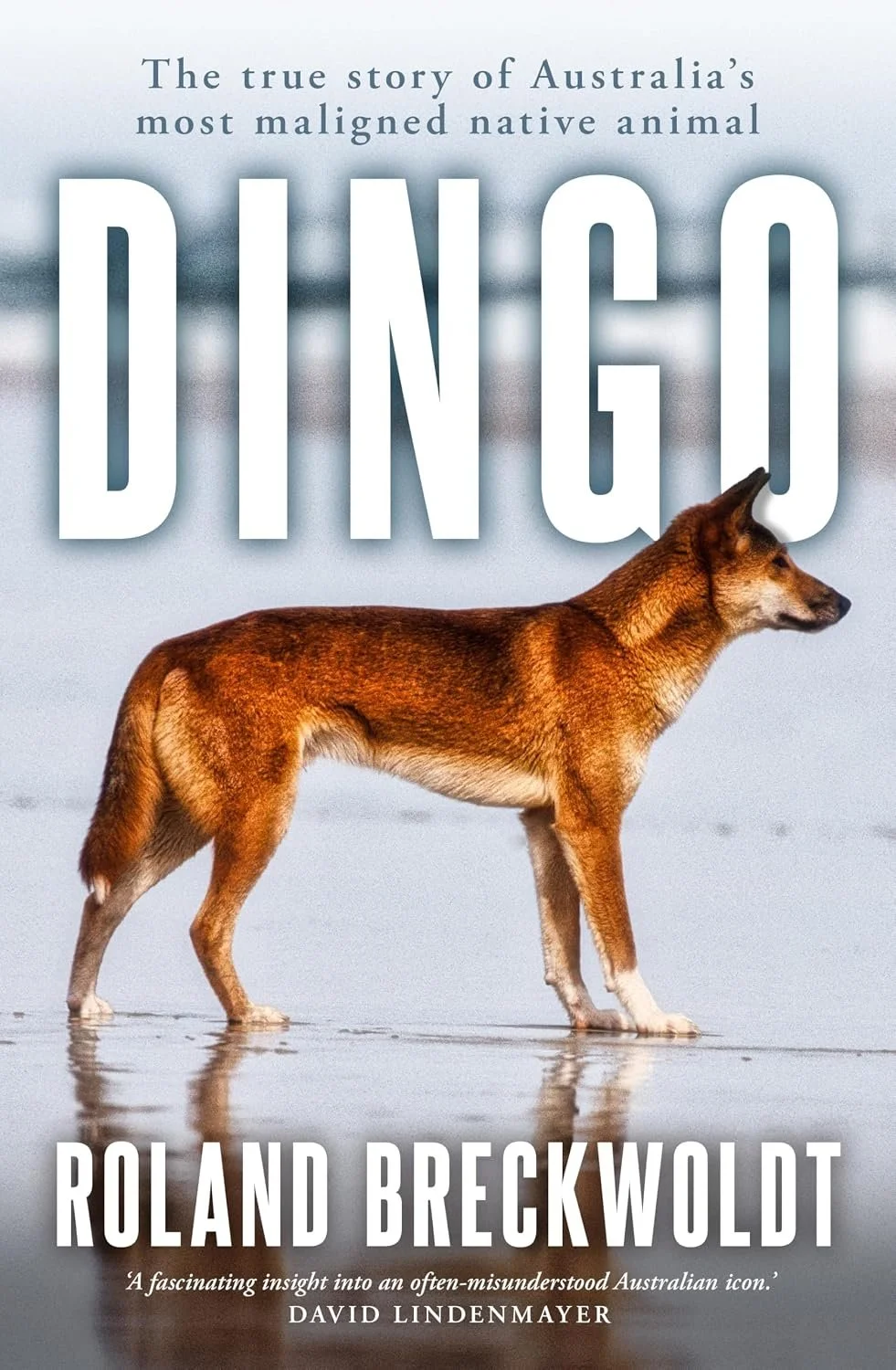
Image source (Amazon.com.au)
Roland Breckwoldt’s Dingo: The true story of Australia's most maligned native animal is an easily accessible, encyclopaedic book about all aspects of Australia’s dingo. Whether you want to know about its evolution, natural history, biology, persecution, cultural role, etc; it is all covered in this book.
Part of the book also tells how Roland first encountered dingoes, while working on large cattle stations. Where to kill a dingo was no big deal. His life journey then found him moving through academia, in the field of agriculture and natural resource management, and his views about dingoes changed, although he still maintained the practicality of a station hand.
When I purchased this book, I was really just after a book about the biology and natural history of the dingo, but I am so glad that this book covered that and more. Some of the most interesting chapters were about the sorrowful interactions between humans and dingoes. Not just how it turned out badly for the dingoes, with bounties placed on their heads, but also how humans suffered because of the way that we had moved into the dingo’s world. One chapter that I had to read all the way through without stopping was about the Azaria Chamberlain case. While the dingo ultimately became the perpetrator in that case, the injustice shown to the family through wilful official incompetence was truly heartbreaking. It would be bad enough for any parent to lose a young child, but then to have that compounded by being sentenced for her murder, would be a horror beyond words.
For anybody interested in the natural history of the dingo, this is a very useful book. I learnt so much from reading this book, about dingo breeding behaviour, how they regularly change dens, etc. Roland has kept dingoes so while the book is based on solid scientific research, he can also share anecdotes of the wild dingoes he has been responsible for.
Roland describes in a lot of detail how much effort was put into destroying the dingo and how in some parts of Australia there remains a bounty on dingoes. He also describes the changing attitudes in understanding what a dingo is, and contesting the narrative that dingoes are only hybrids with feral dogs. This debate is still ongoing, with research released this year, 2026, again showing that there are pure dingoes present in Australia, and that the admixture of domestic dog genes in dingoes is historic. In fact, scientists are also looking at the possibility of evolutionary shared DNA between domestic dogs and dingoes, which may have further complicated an understanding of hybridisation. There is very useful information on the scientific name of the dingo, Canis lupis dingo, and how some Australian authorities want it changed to Canis familiaris dingo, a sub-species of the domesticated dog. This is despite the peak international bodies on taxonomy and naming, already agreeing to Canis lupus dingo, which Roland confirmed via email with the peak international taxonomic agency in late 2023. Unfortunately, some Australian government entities still prefer to use Canis familiaris dingo, or just Canis familiaris, so as to term the dingo as just a wild descendant of domesticated dogs.
The ecological role of the dingo is covered very well, with Roland highlighting how it helps suppress kangaroos, as well as feral predators like foxes and cats. This information was attested to by a number of government sources, including inquiries that showed that the dingo fence did not completely stop dingoes crossing and that it just helped to create a larger kangaroo problem within it.
He doesn’t shy away from research that casts the dingo in a bad light. He references studies that show it does consume farm animals, although it prefers native creatures. He also discussed how dingoes will sometimes overkill, hunting more animals than they need and only eating a few of those dead creatures. It was during this discussion that his practicality about farming came through. While he wrote about non-lethal control measures for dingoes, he noted that the use of guardian animals for flocks would not be that useful on the vast properties that can be found across Australia. Those guardian animals would likely not be regularly in contact with humans and so may become less effective over time.
Overall, this book was a comprehensive synthesis of a vast amount of information about dingoes, across a broad range of fields. I never found the book superficial despite this wide coverage, quite the opposite. Roland doesn’t bog the reader down in facts for show, he writes very well, with his words easy to digest, and the narrative carrying the reader on. It was pleasantly surprising how easy the book was to read despite all the information that he packed into it. I would thoroughly recommend this book for anybody wanting to know more about the dingo.
