
Alpine Dingoes starting their day
A female Alpine Dingo
Canon EOS R1 with a Canon RF 200-800mm F6.3-9 IS USM Lens [ISO 1000, 672mm, f/9.0 and 1/1600])
In mid-September, I was fortunate enough to have another amazing encounter with the beautiful Alpine Dingoes (Canis lupus dingo) of Namadgi National Park. When I photograph dingoes, I generally use a Canon RF 200-800mm F6.3-9 IS USM Lens, normally at 800mm to keep a safe distance from the dingoes, and to reduce any stress on them. In an attempt to further reduce the stress on these dingoes, I have also been regularly visiting this area over the last couple of months so that they became accustomed to my presence. These photos are part of a project that I am working on for my photography diploma at CIT, with this folio highlighting the need to conserve these beautiful animals.
An Alpine Dingo in front of a den
Canon EOS R1 with a Canon RF 200-800mm F6.3-9 IS USM Lens [ISO 1000, 800mm, f/9.0 and 1/3200])
I ended up walking just shy of 10KM that morning enjoying the lovely spring weather. I had seen a dingo already, but at a distance. Looking through my camera, I think it might have been carrying a raven in its mouth, but even with an 800mm lens, it was too far to tell for certain. I had resigned myself that I would not see any more dingoes that morning but at just before 10AM, while I was following a fire trail back towards where I had parked my car, I noticed a dingo outside what was almost certainly a den. In fact, processing my photos later at home, I realised that there were actually two dingoes, the one that caught my attention was in the light, while the other was lying around the side of the rock on the right, in the shade. The obvious dingo, in the light, was yawning and stretching, like it had just woken up. After a few minutes, it climbed down from the den and started to cross my direction of travel, although well ahead of me. I was concerned that it may have been coming to check me out but it kept moving away as I was coming closer on my way back to the car. So as not to cause the dingo any stress, and in an effort to keep away from the den, I split the difference and went between the two locations. Following this heading, I then noticed that another dingo was at the entrance to the den. She was stretching and yawning as well, before she sat down at the entrance and looked around the valley. Eventually, she stood up, and walked down towards the creek behind the den, while, heading in a parallel direction to where I was walking.
The first female
Canon EOS R1 with a Canon RF 200-800mm F6.3-9 IS USM Lens [ISO 1000, 800mm, f/9.0 and 1/3200])
As I said, the first dingo came out and crossed over my direction of travel and kept its distance from me. Looking through the camera, I could tell that she was a female, and that she was yawning a lot. The photo above is as she was starting another yawn, and just before she shut her eyes and opened her mouth fully. After a little while, she sat down in the grass and watched me walking past, while still occasionally yawning.
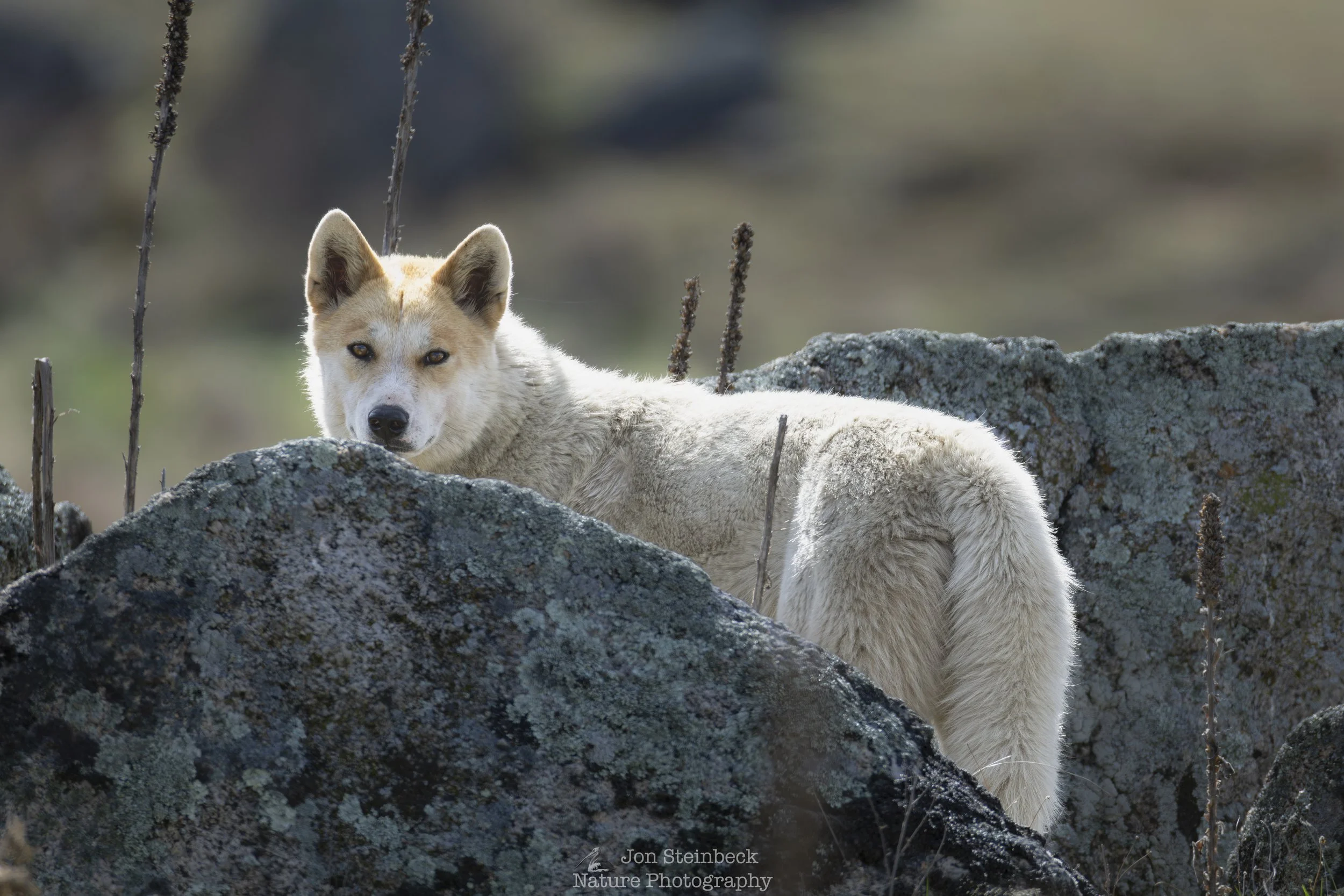
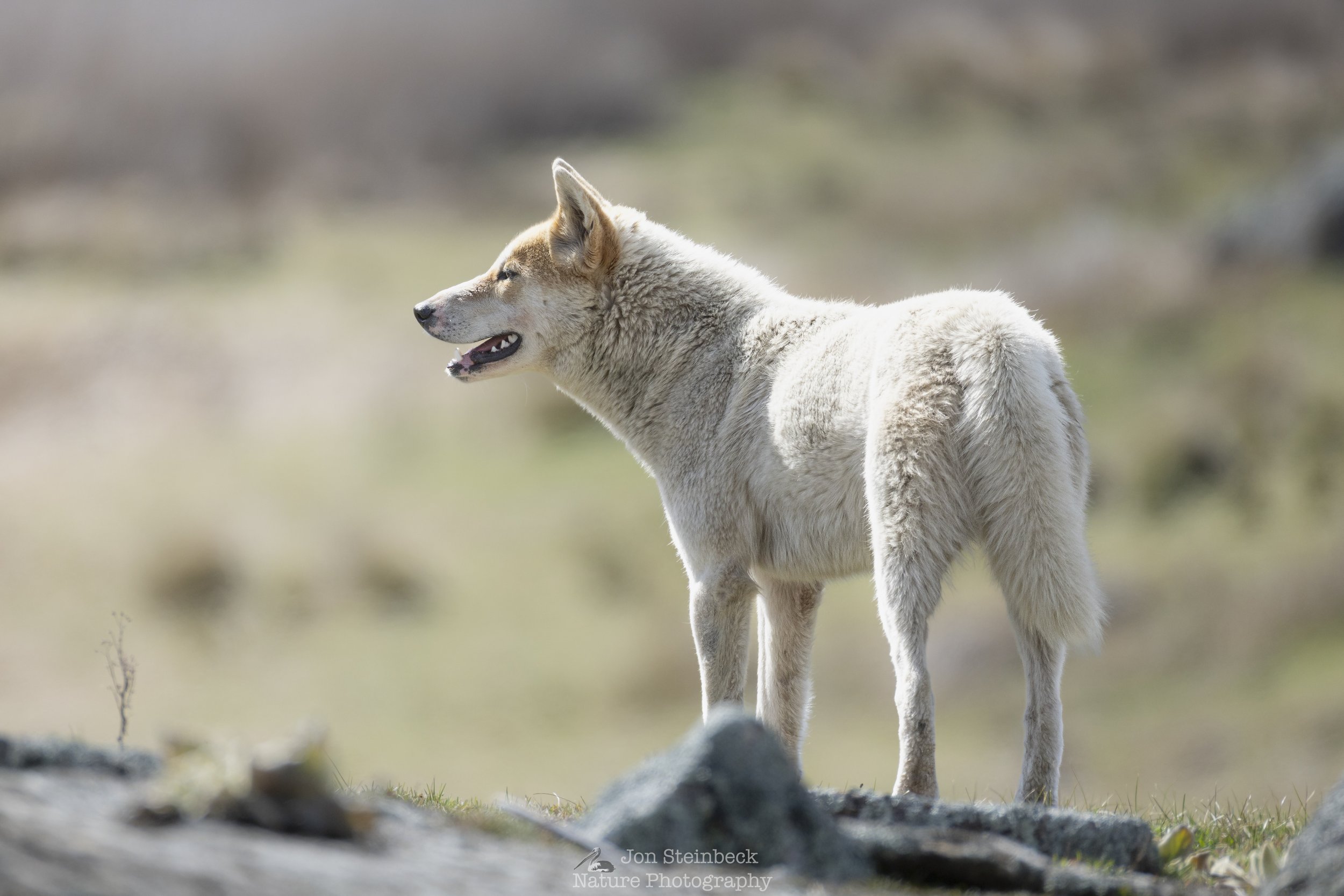
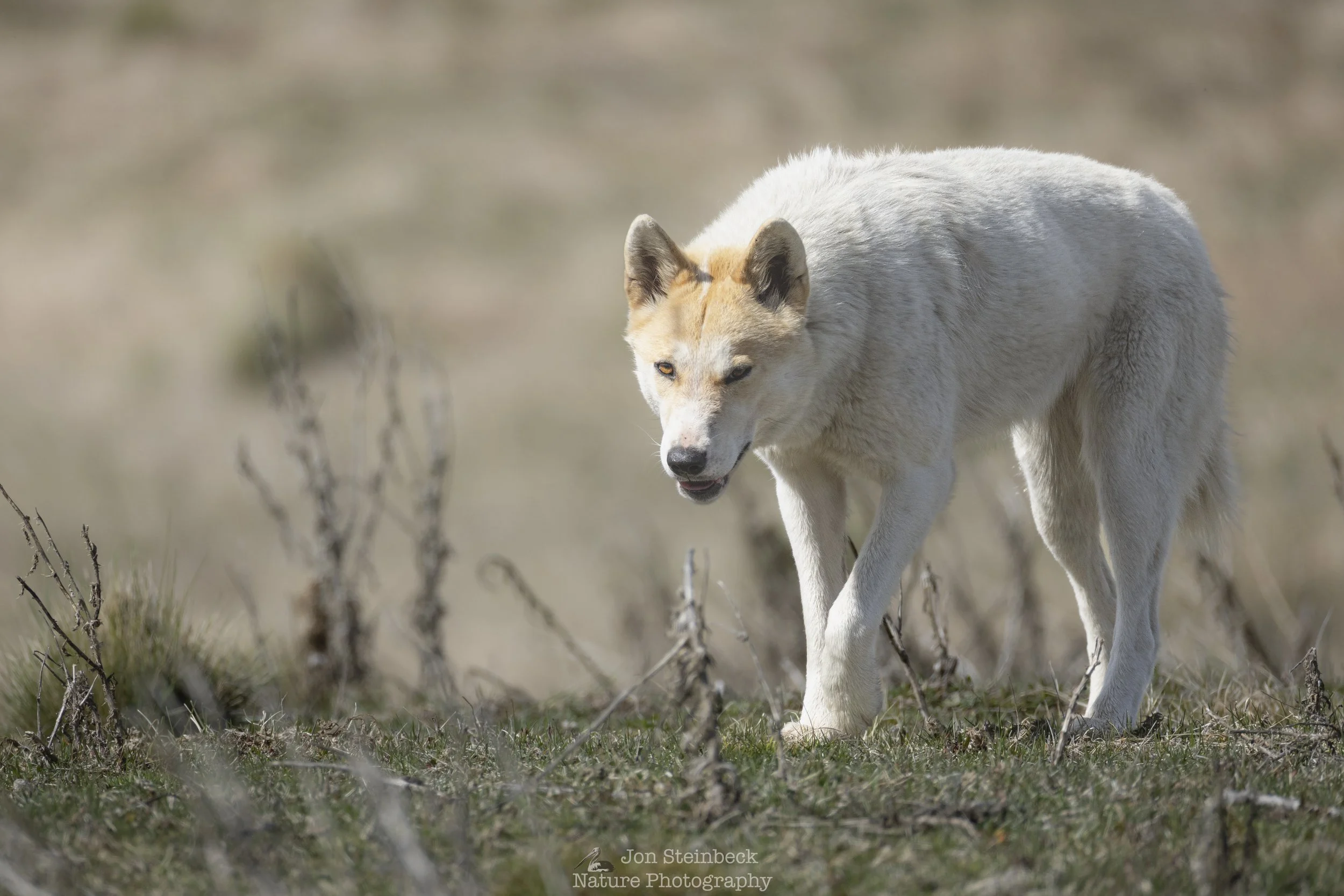
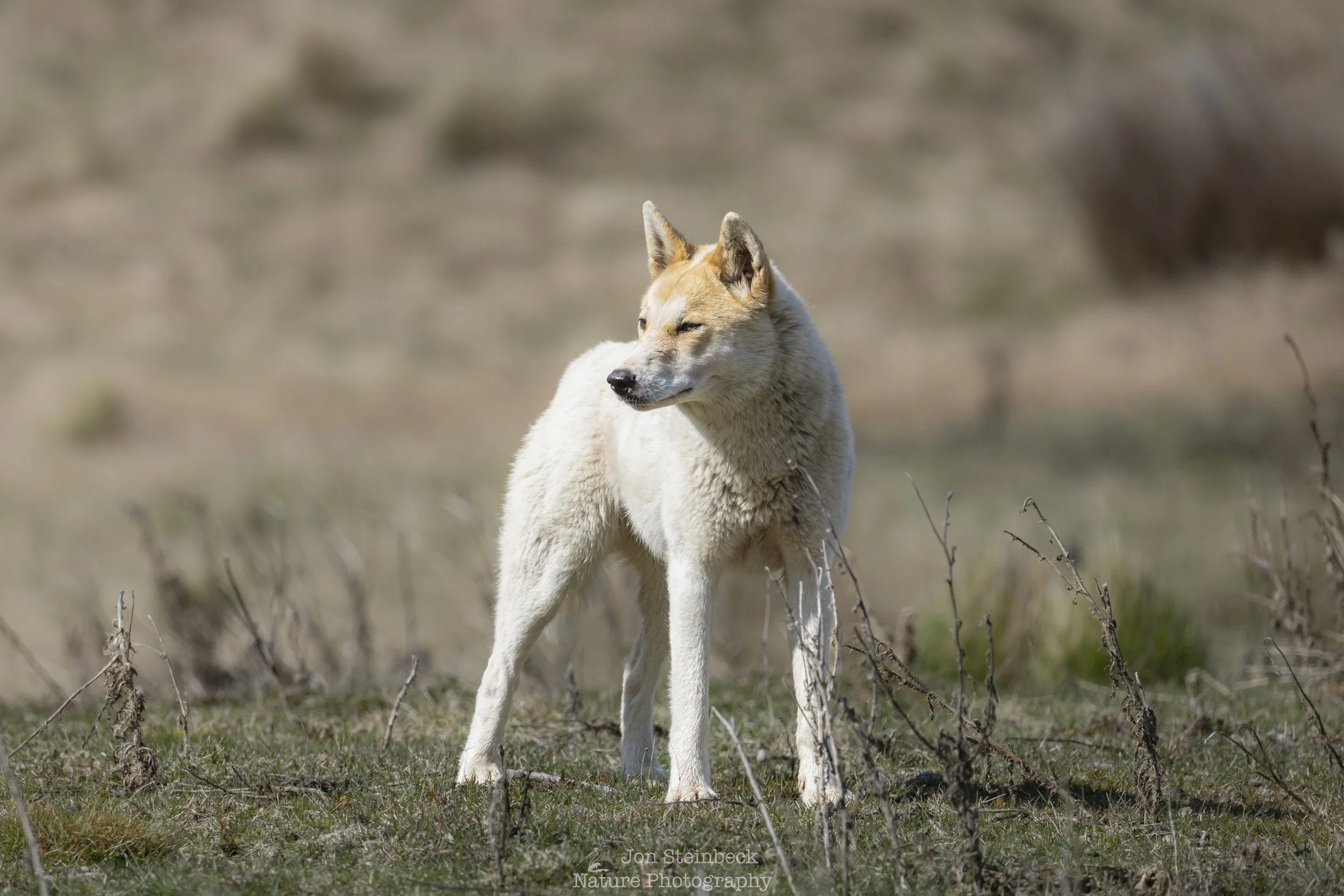
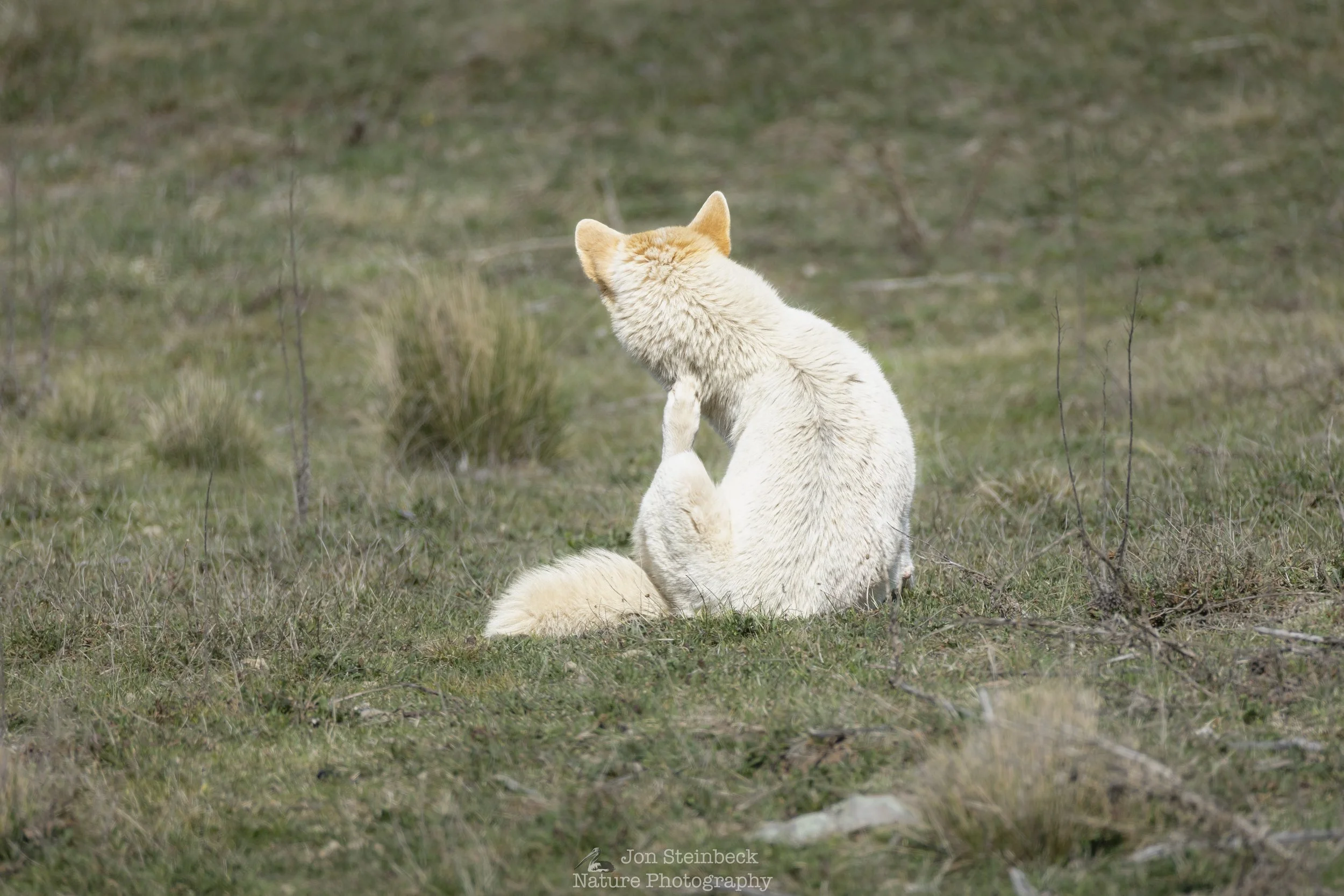
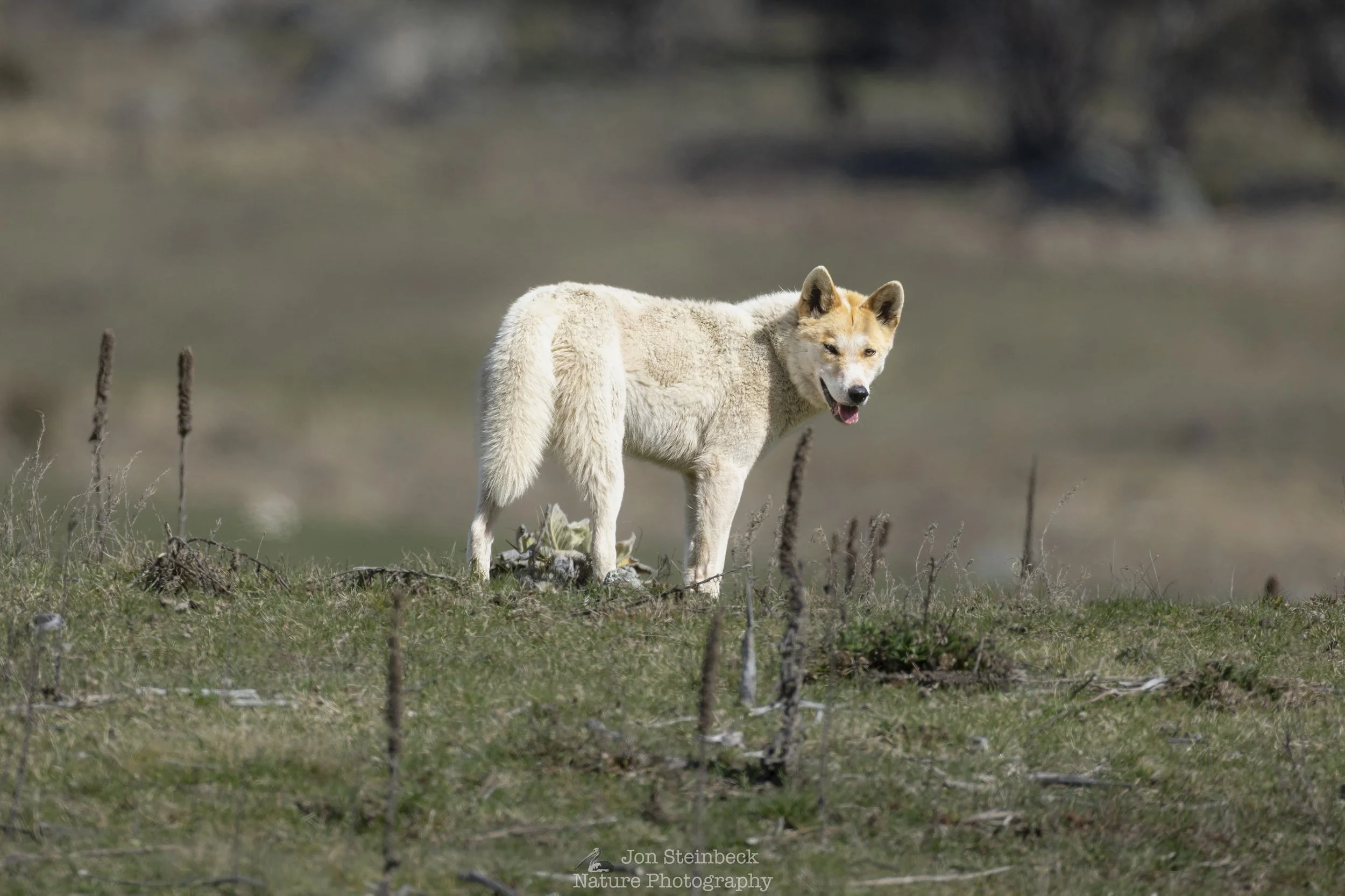
The second female, I am sure, is the same one that I photographed in July, based on the very similar facial markings. Because she headed down to the creek, I hadn’t really seen her clearly but I was hoping that I would see her down at the creek while I stuck to the higher ground. Fortunately, while I was walking along, I suddenly noticed her among some rocks, almost right in front of me. She had come back up from the creek and our paths now crossed. Because she hadn’t seen me, I stopped where I was, to let her notice me first. When she did see me, she was not ruffled, she looked at me, then continued to cross my heading before walking back around my right side, towards the way that I had just come. I stayed put the whole time that she was near me, letting her control how much distance she wanted between us, so that she didn’t feel threatened. She wasn’t rushing away from me. She would occasionally pause and look around in different directions, even turning her back on me to sit down and have a good scratch at something on her neck. She was beautiful, and I am glad that she picked up a scent and followed it in my direction for a little while so that I could photograph her with her eyes facing the sun, revealing the amazing colour that these dingoes have in their irises.
She continued walking back along the way that I had come, giving one good look back at me before she walked down a slope. I noticed that she was sniffing at the ground while she was moving, especially when she headed back down towards the creek, and then I saw that there was actually a third dingo, a male, already down near the creek.
A male Alpine Dingo
Canon EOS R1 with a Canon RF 200-800mm F6.3-9 IS USM Lens [ISO 1000, 800mm, f/9.0 and 1/2500])
The male, was one that I believed that I photographed in July with the second female, based on the ginger mark on his flank and the ginger colouring on the left side of his head. He was already down in the creek and soak area, and didn’t look at me once. The second female joined him down there, but I lost sight of them among the long vegetation. I also became distracted looking at the first female, who had now returned to the slope behind the den.
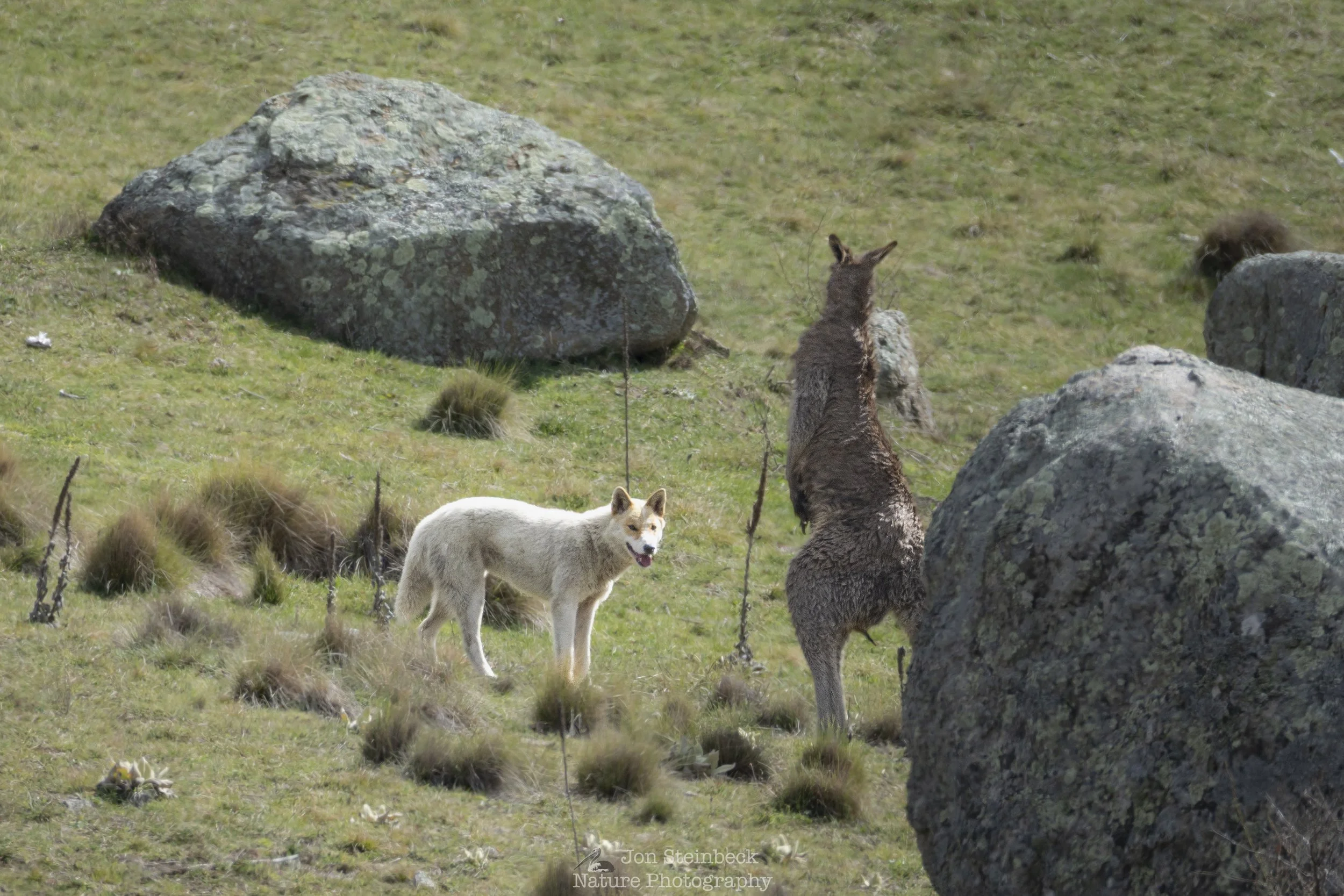
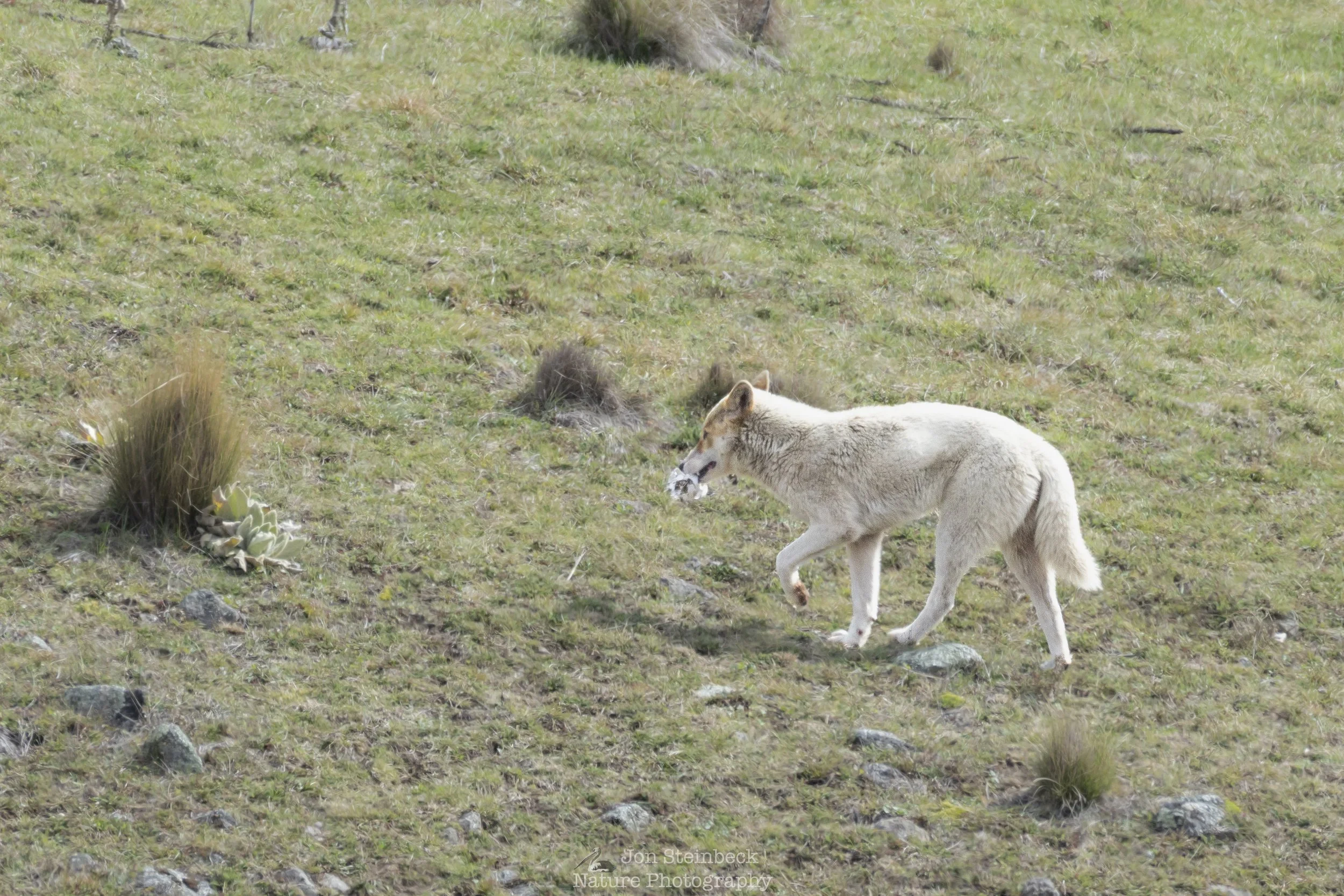
She had crossed back over to the den while I was enthralled watching the other female. The first female stayed on the slope behind the den. She eventually almost bumped into a male Eastern Grey Kangaroo that was feeding there. This kangaroo had already watched two other dingoes pass it, without hopping away. I wasn’t sure what the female dingo was going to do against an almost full size male kangaroo, but she looked at him for a little while, before turning and walking off. You can see that the male kangaroo pulled himself up to his full height, and had his tail down ready to kick if needed. It was interesting to see how close the dingo approached the kangaroo, yet also how the kangaroo was able to deter the dingo by standing its ground rather than fleeing. The kangaroo’s success does seem to confirm the advice from ACT Environment about what to do if a dingo approaches you.
In the unlikely event of threatening behaviour:
stay alert but calm
do not run or wave your arms because it can trigger an attack
face the animal, stand still at full height, fold your arms across your chest, and keep eye contact with the animal.
calmly back away, and if you are with another person, stand back-to-back.
The female then sniffed at a very old and white kangaroo skull, nudging it with her nose before gripping it in her jaw to carry it off. She walked a little way up the slope, before putting the skull down and sniffing it again. She then lost interest in the skull and laid down on her front, watching the area where the other two dingoes had gone.
That morning had been a completely unexpected encounter, after the last couple of weeks when I had hardly seen any dingoes. To me, the dingoes acted like they had just woken up and were taking a little while to get going, making them a bit slower than they can be. The highpoint had been getting to see the female again, and to watch her at close range, while she seemed not to care that much about my presence. I treat these dingoes with the utmost respect, especially at present when they may be caring for pups, and I use a long lens to keep my distance. I am also happy when I see a dingo that is not that fearful of a human, and I let the dingo control how close it wants to get to me. Hopefully, by treating dingoes with respect it means that we can continue to observe these spectactular animals without causing them stress.
